Table of contents
- 0. Review of College Algebra4h 45m
- 1. Measuring Angles40m
- 2. Trigonometric Functions on Right Triangles2h 5m
- 3. Unit Circle1h 19m
- 4. Graphing Trigonometric Functions1h 19m
- 5. Inverse Trigonometric Functions and Basic Trigonometric Equations1h 41m
- 6. Trigonometric Identities and More Equations2h 34m
- 7. Non-Right Triangles1h 38m
- 8. Vectors2h 25m
- 9. Polar Equations2h 5m
- 10. Parametric Equations1h 6m
- 11. Graphing Complex Numbers1h 7m
7. Non-Right Triangles
Law of Sines
Problem 3c
Textbook Question
In each figure, a line segment of length L is to be drawn from the given point to the positive x-axis in order to form a triangle. For what value(s) of L can we draw the following?
c. no triangle
<IMAGE>
Verified step by step guidance1
Identify the given point's coordinates and the angle it makes with the positive x-axis, if provided, or determine the vertical distance from the point to the x-axis.
Recall that the line segment of length \(L\) is drawn from the point to the positive x-axis, forming a triangle with the x-axis and the segment from the origin to the foot of the perpendicular.
Understand that a triangle can be formed only if the length \(L\) is greater than the shortest distance from the point to the x-axis; if \(L\) is less than this distance, no triangle can be formed.
Express the shortest distance from the point to the x-axis mathematically, which is the absolute value of the y-coordinate of the point, say \(d = |y|\).
Conclude that for no triangle to be formed, the length \(L\) must satisfy \(L < d\), meaning the segment is too short to reach the x-axis and form a triangle.
Verified video answer for a similar problem:This video solution was recommended by our tutors as helpful for the problem above
Play a video:
0 Comments
Key Concepts
Here are the essential concepts you must grasp in order to answer the question correctly.
Triangle Inequality Theorem
The Triangle Inequality Theorem states that the sum of the lengths of any two sides of a triangle must be greater than the length of the remaining side. This principle helps determine whether a triangle can be formed given certain side lengths, ensuring the segments can connect to form a closed shape.
Recommended video:
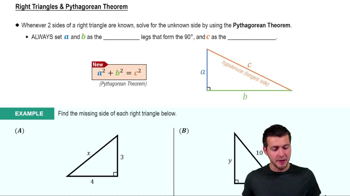
Solving Right Triangles with the Pythagorean Theorem
Distance from a Point to the x-axis
The distance from a point to the x-axis is the absolute value of the point's y-coordinate. This distance is crucial when drawing a segment from the point to the x-axis, as it sets a minimum length for the segment and influences the possible lengths L that can form a triangle.
Recommended video:
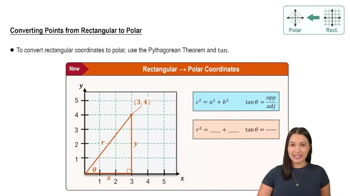
Convert Points from Rectangular to Polar
Conditions for No Triangle Formation
No triangle is formed when the segment length L violates the triangle inequality, such as being too short or too long relative to other sides. Understanding these conditions helps identify values of L for which a triangle cannot exist, often involving equality or impossible side length combinations.
Recommended video:
Evaluating Sums and Differences Given Conditions
Related Videos
Related Practice
Textbook Question
In Exercises 17–32, two sides and an angle (SSA) of a triangle are given. Determine whether the given measurements produce one triangle, two triangles, or no triangle at all. Solve each triangle that results. Round to the nearest tenth and the nearest degree for sides and angles, respectively.a = 57.5, c = 49.8, A = 136°
608
views