In each figure, a line segment of length L is to be drawn from the given point to the positive x-axis in order to form a triangle. For what value(s) of L can we draw the following? a. two triangles <IMAGE>
Verified step by step guidance
1
Identify the given point's coordinates and the angle(s) involved in forming the triangle with the positive x-axis. This will help set up the geometric relationship.
Recall that the length L represents the segment from the given point to the x-axis, which acts as the height or a side of the triangle depending on the configuration.
Use the Law of Sines or the Pythagorean theorem to relate the length L, the given distances, and the angles in the triangle. This will give an equation involving L.
Analyze the equation to determine for which values of L there are two possible solutions (two triangles). This typically happens when the segment length allows for two different triangle configurations (ambiguous case).
Express the conditions on L explicitly by solving inequalities or equations derived from the triangle properties, identifying the range of L values that produce two distinct triangles.
Verified video answer for a similar problem:
This video solution was recommended by our tutors as helpful for the problem above
Play a video:
0 Comments
Key Concepts
Here are the essential concepts you must grasp in order to answer the question correctly.
Triangle Formation with a Given Side Length
This concept involves understanding how a line segment of fixed length can be positioned to form a triangle with a given point and axis. It requires analyzing the geometric constraints that allow one, two, or no triangles to be formed based on the length and position of the segment.
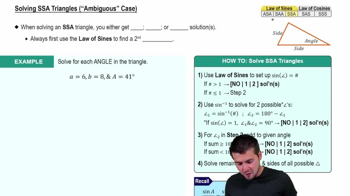
The ambiguous case arises when two sides and a non-included angle (SSA) are known, potentially yielding zero, one, or two triangles. This concept helps determine the number of possible triangles by comparing the given length to the height of the triangle formed from the known angle.
Trigonometric Relationships and Height Calculation
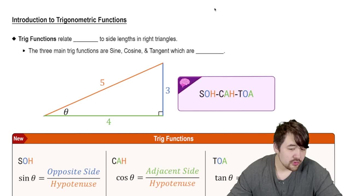
Calculating the height of the triangle using trigonometric functions like sine is essential to compare with the given segment length. This height determines whether the segment can form one or two triangles when dropped perpendicularly to the base or axis.