Find the magnitude and direction angle for each vector. Round angle measures to the nearest tenth, as necessary. See Example 1. 〈8√2, -8√2〉
Verified step by step guidance
1
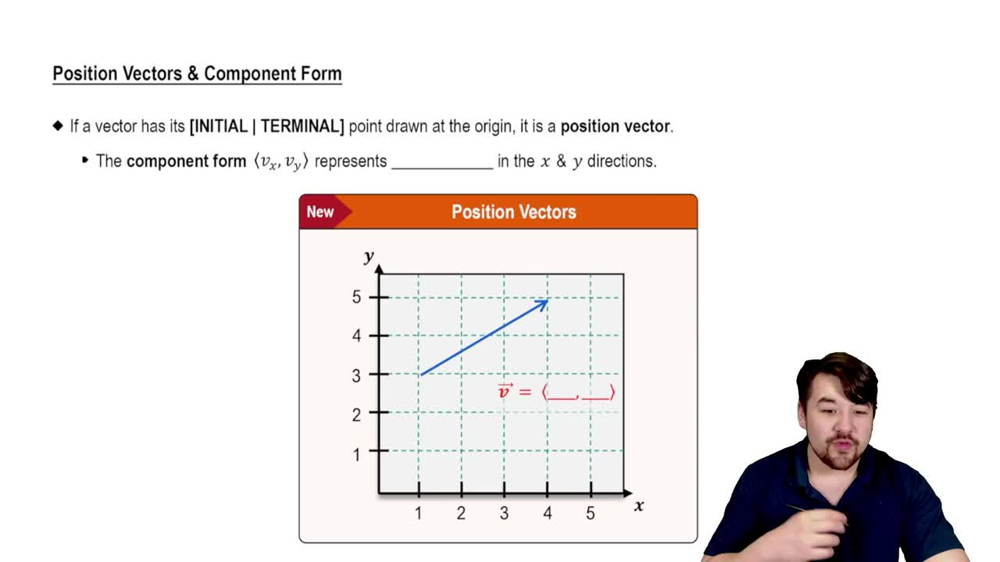
Identify the components of the vector. Here, the vector is given as \(\langle 8\sqrt{2}, -8\sqrt{2} \rangle\), where the x-component is \(8\sqrt{2}\) and the y-component is \(-8\sqrt{2}\).
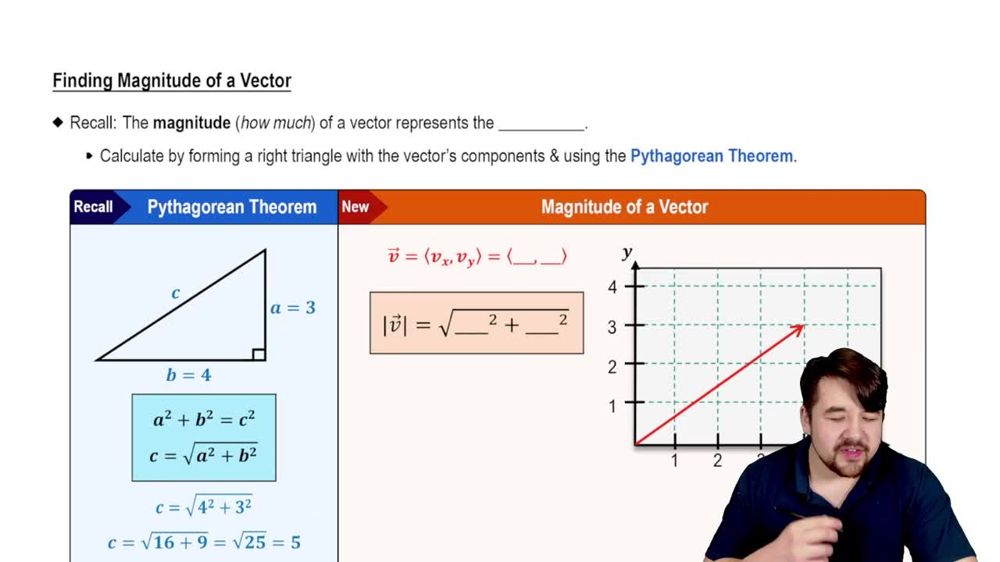
Calculate the magnitude of the vector using the formula \(\text{magnitude} = \sqrt{x^2 + y^2}\). Substitute the components: \(\sqrt{(8\sqrt{2})^2 + (-8\sqrt{2})^2}\).
Simplify the expression inside the square root by squaring each component and adding them together.
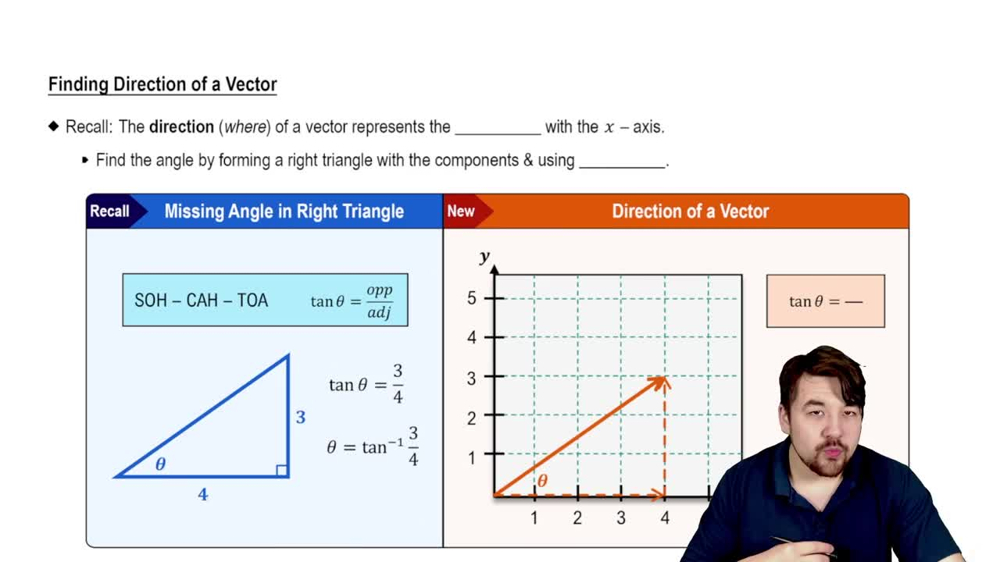
Find the direction angle \(\theta\) using the formula \(\theta = \tan^{-1}\left( \frac{y}{x} \right)\). Substitute the components: \(\theta = \tan^{-1}\left( \frac{-8\sqrt{2}}{8\sqrt{2}} \right)\).
Determine the correct quadrant for the angle based on the signs of the x and y components, then adjust the angle accordingly to find the direction angle measured counterclockwise from the positive x-axis. Round the angle to the nearest tenth of a degree.
Verified video answer for a similar problem:
This video solution was recommended by our tutors as helpful for the problem above
Video duration:
5m
Play a video:
0 Comments
Key Concepts
Here are the essential concepts you must grasp in order to answer the question correctly.
Vector Magnitude
The magnitude of a vector represents its length and is calculated using the Pythagorean theorem. For a vector with components (x, y), the magnitude is √(x² + y²). This gives a non-negative scalar value indicating the vector's size regardless of direction.
The direction angle of a vector is the angle it makes with the positive x-axis, measured counterclockwise. It can be found using the inverse tangent function: θ = arctan(y/x). Adjustments may be needed based on the vector's quadrant to get the correct angle.
Vectors with components involving radicals, like √2, require careful arithmetic when calculating magnitude and direction. Simplifying expressions and using exact values before rounding helps maintain accuracy in the final results.