Concept Check Work each problem. Find the equation of the line that passes through the origin and makes a 30Β° angle with the x-axis.
Table of contents
- 0. Review of College Algebra4h 45m
- 1. Measuring Angles40m
- 2. Trigonometric Functions on Right Triangles2h 5m
- 3. Unit Circle1h 19m
- 4. Graphing Trigonometric Functions1h 19m
- 5. Inverse Trigonometric Functions and Basic Trigonometric Equations1h 41m
- 6. Trigonometric Identities and More Equations2h 34m
- 7. Non-Right Triangles1h 38m
- 8. Vectors2h 25m
- 9. Polar Equations2h 5m
- 10. Parametric Equations1h 6m
- 11. Graphing Complex Numbers1h 7m
3. Unit Circle
Trigonometric Functions on the Unit Circle
Problem 8
Textbook Question
In Exercises 5β18, the unit circle has been divided into twelve equal arcs, corresponding to t-values of 0, π, π, π, 2π, 5π, π, 7π, 4π, 3π, 5π, 11π, and 2π. 6 3 2 3 6 6 3 2 3 6 Use the (x,y) coordinates in the figure to find the value of each trigonometric function at the indicated real number, t, or state that the expression is undefined.

cos 2π/3
Verified step by step guidance1
Identify the angle given: \(t = \frac{2\pi}{3}\).
Locate the point on the unit circle corresponding to \(t = \frac{2\pi}{3}\). From the image, this point is \(\left(-\frac{1}{2}, \frac{\sqrt{3}}{2}\right)\).
Recall that on the unit circle, the coordinates \((x, y)\) correspond to \((\cos t, \sin t)\) respectively.
Since we need to find \(\cos \frac{2\pi}{3}\), take the x-coordinate of the point, which is \(-\frac{1}{2}\).
Therefore, \(\cos \frac{2\pi}{3} = -\frac{1}{2}\).
Verified video answer for a similar problem:This video solution was recommended by our tutors as helpful for the problem above
Video duration:
1mPlay a video:
0 Comments
Key Concepts
Here are the essential concepts you must grasp in order to answer the question correctly.
Unit Circle and Coordinates
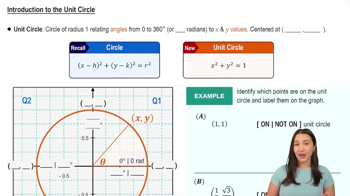
The unit circle is a circle with radius 1 centered at the origin of the coordinate plane. Each point on the circle corresponds to an angle t measured in radians from the positive x-axis. The coordinates (x, y) of each point represent the cosine and sine of the angle t, respectively.
Recommended video:
Introduction to the Unit Circle
Trigonometric Functions on the Unit Circle
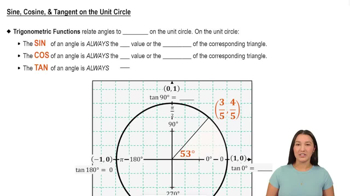
Cosine and sine functions can be directly found from the x and y coordinates of points on the unit circle. For an angle t, cos(t) is the x-coordinate and sin(t) is the y-coordinate of the corresponding point on the circle.
Recommended video:
Sine, Cosine, & Tangent on the Unit Circle
Special Angles and Their Values
Certain angles, such as multiples of Ο/6 and Ο/3, have well-known exact trigonometric values. These values are often expressed in terms of square roots and fractions, allowing precise evaluation of trigonometric functions without a calculator.
Recommended video:
45-45-90 Triangles
Related Videos
Related Practice
Textbook Question
707
views