Find the exact value of each real number y. Do not use a calculator. y = arccot (―1)
Verified step by step guidance
1
Recall the definition of the arccotangent function: \(y = \arccot(x)\) means \(\cot(y) = x\) and \(y\) lies in the principal range of arccot, which is usually \(0 < y < \pi\) for real numbers.
Set up the equation from the problem: \(\cot(y) = -1\).
Recall that \(\cot(y) = \frac{\cos(y)}{\sin(y)}\). So, \(\frac{\cos(y)}{\sin(y)} = -1\) implies \(\cos(y) = -\sin(y)\).
Divide both sides by \(\cos(y)\) (assuming \(\cos(y) \neq 0\)) to get \(1 = -\tan(y)\), or equivalently \(\tan(y) = -1\).
Find the angle \(y\) in the interval \((0, \pi)\) where \(\tan(y) = -1\). This corresponds to the angle where tangent is negative and equals \(-1\).
Verified video answer for a similar problem:
This video solution was recommended by our tutors as helpful for the problem above
Play a video:
0 Comments
Key Concepts
Here are the essential concepts you must grasp in order to answer the question correctly.
Inverse Cotangent Function (arccot)
The arccot function is the inverse of the cotangent function, returning an angle whose cotangent is the given value. It is important to understand its principal value range, typically (0, π), to find the correct angle without ambiguity.
Cotangent is defined as the ratio of the adjacent side to the opposite side in a right triangle, or cot(θ) = cos(θ)/sin(θ). Knowing common cotangent values, such as cot(3π/4) = -1, helps in identifying the exact angle corresponding to a given cotangent value.
Certain angles like π/4, π/3, and π/6 have well-known trigonometric values. Recognizing these special angles and their cotangent values allows for determining exact values without a calculator, which is essential for solving inverse trigonometric problems.

 Verified step by step guidance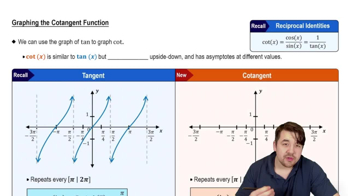
 5:37
5:37