Find the exact value of each real number y. Do not use a calculator. y = sec⁻¹ (―2)
Verified step by step guidance
1
Recall that the function \( y = \sec^{-1}(x) \) is the inverse secant function, which gives an angle \( y \) such that \( \sec y = x \). Here, we want to find \( y \) such that \( \sec y = -2 \).
Use the identity relating secant and cosine: \( \sec y = \frac{1}{\cos y} \). So, \( \sec y = -2 \) implies \( \frac{1}{\cos y} = -2 \), which means \( \cos y = -\frac{1}{2} \).
Determine the range of \( y = \sec^{-1}(x) \). By definition, \( y \) lies in \( [0, \pi] \) excluding \( \frac{\pi}{2} \), because secant is not defined at \( \frac{\pi}{2} \).
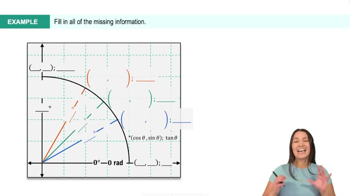
Find all angles \( y \) in the interval \( [0, \pi] \) where \( \cos y = -\frac{1}{2} \). Recall the unit circle values where cosine equals \( -\frac{1}{2} \).
Select the angle(s) from the previous step that satisfy the domain of \( \sec^{-1} \) and write the exact value(s) of \( y \) accordingly.
Verified video answer for a similar problem:
This video solution was recommended by our tutors as helpful for the problem above
Play a video:
0 Comments
Key Concepts
Here are the essential concepts you must grasp in order to answer the question correctly.
Inverse Secant Function (sec⁻¹ or arcsec)
The inverse secant function, sec⁻¹(x), returns the angle whose secant is x. It is defined for |x| ≥ 1, and its range is typically [0, π] excluding π/2. Understanding this helps find the angle y such that sec(y) = -2.
Secant is the reciprocal of cosine, so sec(y) = 1/cos(y). To find y when sec(y) = -2, we rewrite it as cos(y) = -1/2. This relationship allows us to use cosine values to determine the angle.
Certain angles have well-known cosine values, such as cos(120°) = cos(2π/3) = -1/2. Recognizing these exact values enables finding the precise angle y without a calculator when given sec(y) = -2.

 Verified step by step guidance
 6:22
6:22