Given vectors u and v, find: 2u + 3v. u = 〈-1, 2〉, v = 〈3, 0〉
Verified step by step guidance
1
Identify the given vectors: \( \mathbf{u} = \langle -1, 2 \rangle \) and \( \mathbf{v} = \langle 3, 0 \rangle \).
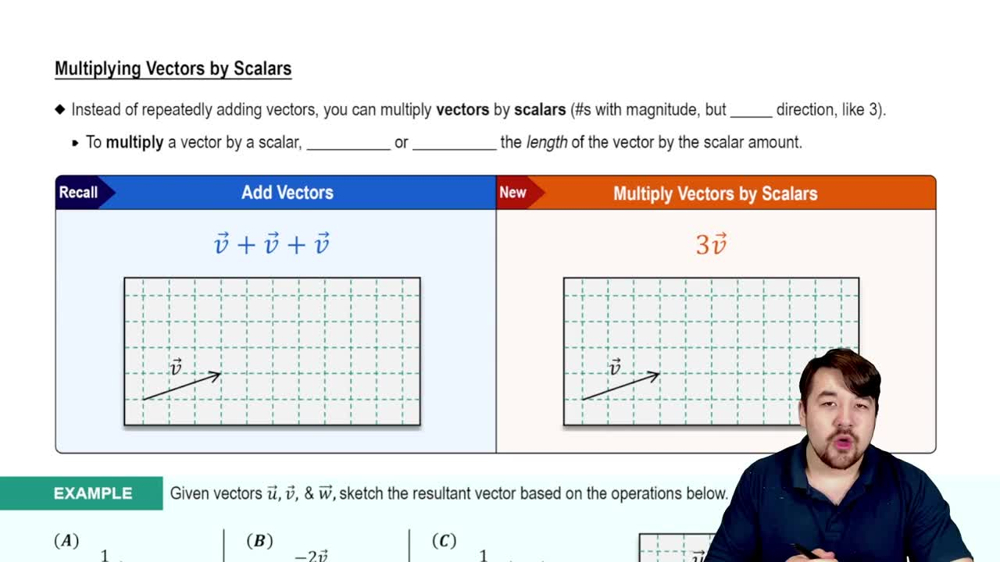
Multiply vector \( \mathbf{u} \) by the scalar 2: calculate \( 2\mathbf{u} = 2 \times \langle -1, 2 \rangle \).
Multiply vector \( \mathbf{v} \) by the scalar 3: calculate \( 3\mathbf{v} = 3 \times \langle 3, 0 \rangle \).
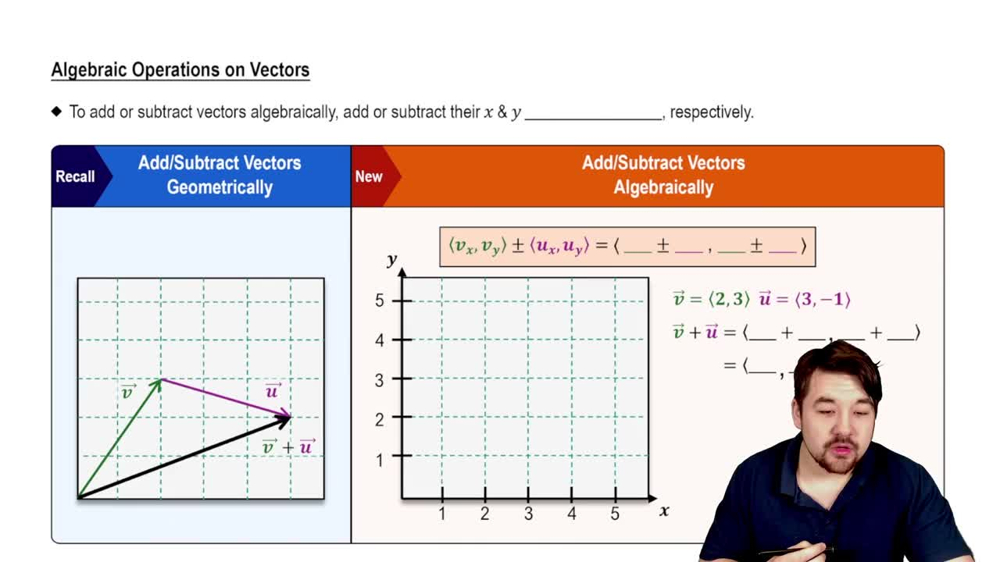
Add the resulting vectors from steps 2 and 3 component-wise: \( 2\mathbf{u} + 3\mathbf{v} = \langle 2u_1 + 3v_1, 2u_2 + 3v_2 \rangle \), where \( u_1, u_2 \) and \( v_1, v_2 \) are the components of \( \mathbf{u} \) and \( \mathbf{v} \) respectively.
Write the final vector as the sum of the components found in step 4, which represents \( 2\mathbf{u} + 3\mathbf{v} \).
Verified video answer for a similar problem:
This video solution was recommended by our tutors as helpful for the problem above
Play a video:
0 Comments
Key Concepts
Here are the essential concepts you must grasp in order to answer the question correctly.
Vector Addition
Vector addition involves combining two vectors by adding their corresponding components. For vectors u = 〈u₁, u₂〉 and v = 〈v₁, v₂〉, the sum u + v is 〈u₁ + v₁, u₂ + v₂〉. This operation results in a new vector representing the combined effect of both.
Scalar multiplication scales a vector by multiplying each of its components by a real number (scalar). For a scalar k and vector u = 〈u₁, u₂〉, the product k*u is 〈k*u₁, k*u₂〉. This changes the vector's magnitude without altering its direction unless the scalar is negative.
Operations on 2D vectors are performed component-wise, meaning each x and y component is handled separately. This approach simplifies calculations like 2u + 3v by first scaling each vector and then adding corresponding components to find the resultant vector.

 Verified step by step guidance
 05:29
05:29