Given vectors u and v, find: v - 3u. u = 2i, v = i + j
Verified step by step guidance
1
Identify the given vectors: \( \mathbf{u} = 2\mathbf{i} \) and \( \mathbf{v} = \mathbf{i} + \mathbf{j} \).
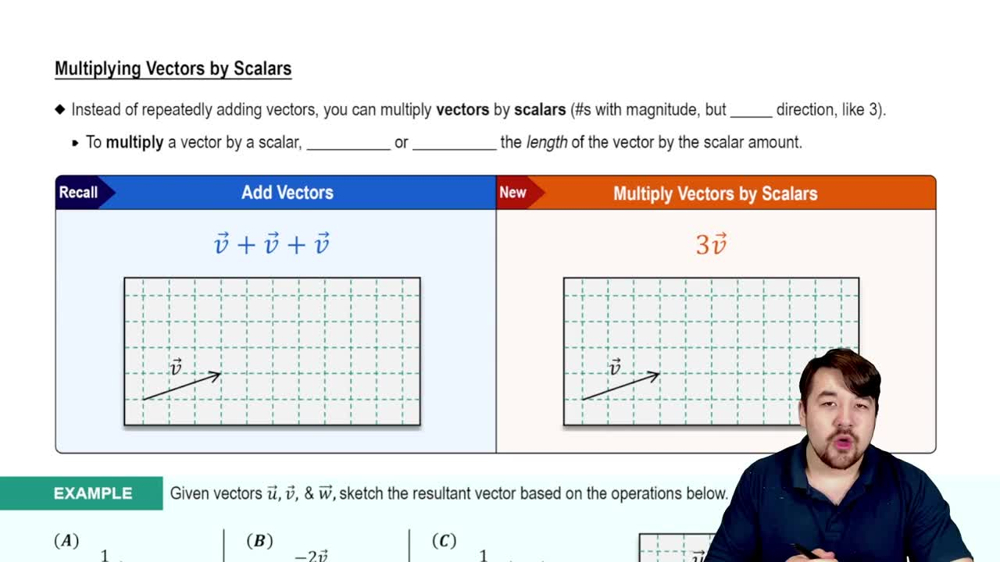
Multiply vector \( \mathbf{u} \) by the scalar 3: calculate \( 3\mathbf{u} = 3 \times 2\mathbf{i} \).
Express \( 3\mathbf{u} \) in component form after multiplication.
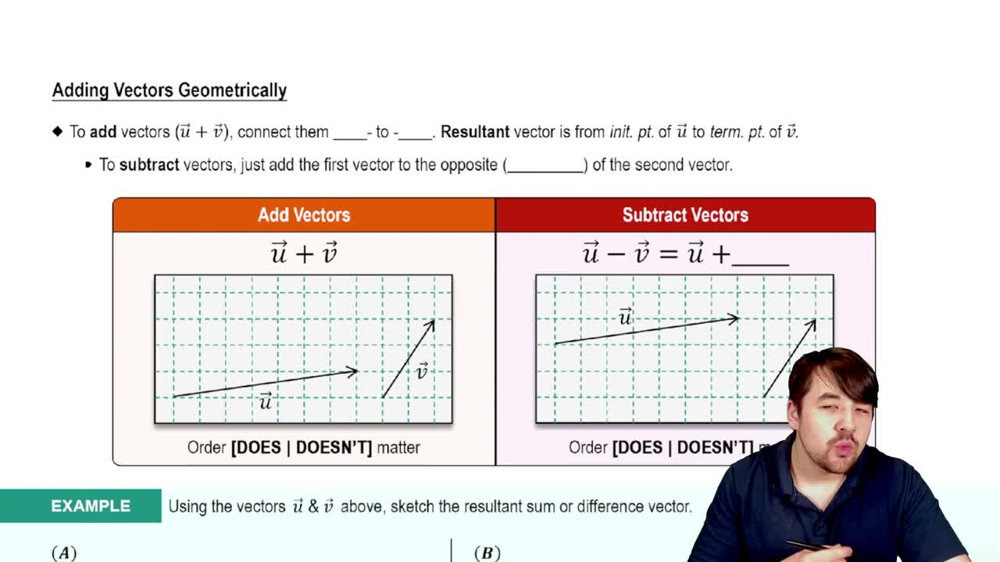
Subtract \( 3\mathbf{u} \) from \( \mathbf{v} \) by subtracting corresponding components: \( \mathbf{v} - 3\mathbf{u} = (\mathbf{i} + \mathbf{j}) - (\text{components of } 3\mathbf{u}) \).
Write the resulting vector in terms of \( \mathbf{i} \) and \( \mathbf{j} \) components to complete the expression for \( \mathbf{v} - 3\mathbf{u} \).
Verified video answer for a similar problem:
This video solution was recommended by our tutors as helpful for the problem above
Play a video:
0 Comments
Key Concepts
Here are the essential concepts you must grasp in order to answer the question correctly.
Vector Representation in Component Form
Vectors can be expressed as sums of their components along the coordinate axes, typically using unit vectors i and j for the x and y directions. For example, u = 2i means the vector has a magnitude of 2 along the x-axis and zero along the y-axis.
Scalar multiplication involves multiplying each component of a vector by a scalar value. For instance, multiplying vector u by 3 scales its magnitude by 3, resulting in 3u = 6i if u = 2i.
Adding or subtracting vectors is done component-wise by combining their respective i and j components. To find v - 3u, subtract the components of 3u from those of v, resulting in a new vector.

 Verified step by step guidance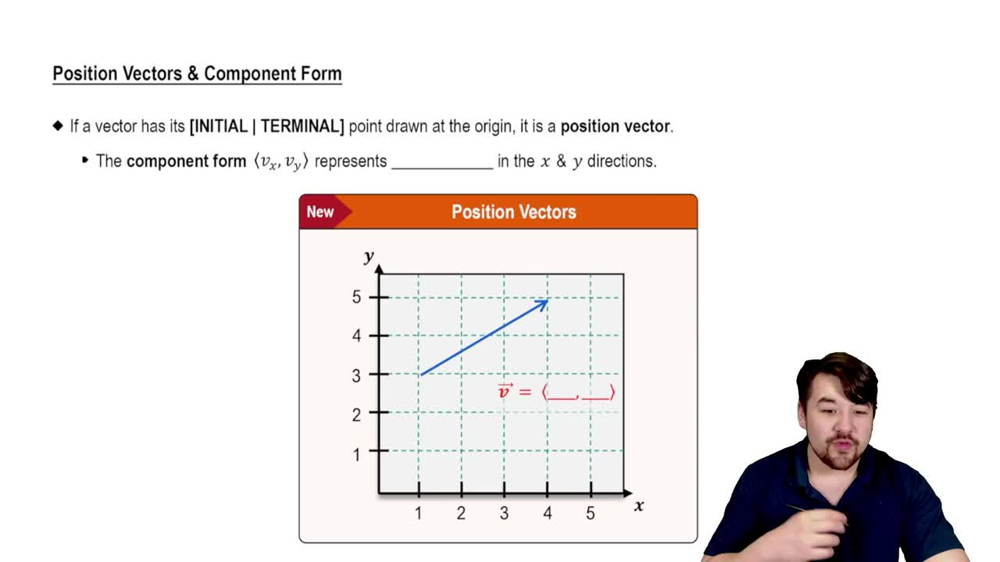
 03:55
03:55