Given vectors u and v, find: 2u. u = 〈-1, 2〉, v = 〈3, 0〉
Verified step by step guidance
1
Identify the vector \( \mathbf{u} = \langle -1, 2 \rangle \) and the scalar multiplier, which is 2 in this case.
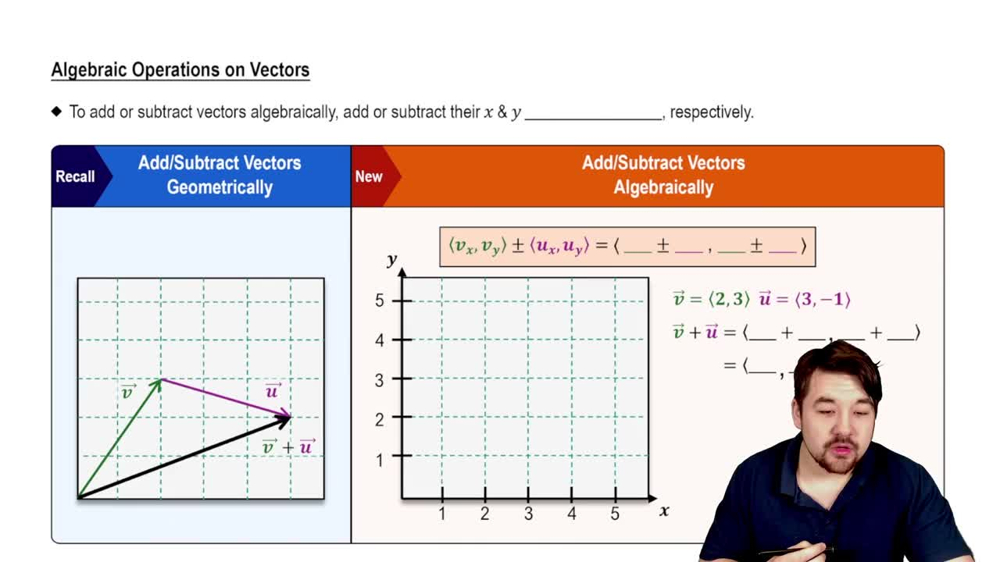
Recall that multiplying a vector by a scalar means multiplying each component of the vector by that scalar.
Apply the scalar multiplication to vector \( \mathbf{u} \): multiply the first component by 2 and the second component by 2.
Write the resulting vector as \( 2\mathbf{u} = \langle 2 \times (-1), 2 \times 2 \rangle \).
Simplify the components to express the final vector in the form \( \langle a, b \rangle \), where \( a \) and \( b \) are the products from the previous step.
Verified video answer for a similar problem:
This video solution was recommended by our tutors as helpful for the problem above
Play a video:
0 Comments
Key Concepts
Here are the essential concepts you must grasp in order to answer the question correctly.
Vector Scalar Multiplication
Scalar multiplication involves multiplying each component of a vector by a scalar (a real number). For example, multiplying vector u = 〈x, y〉 by 2 results in 2u = 〈2x, 2y〉. This operation scales the vector's magnitude without changing its direction.
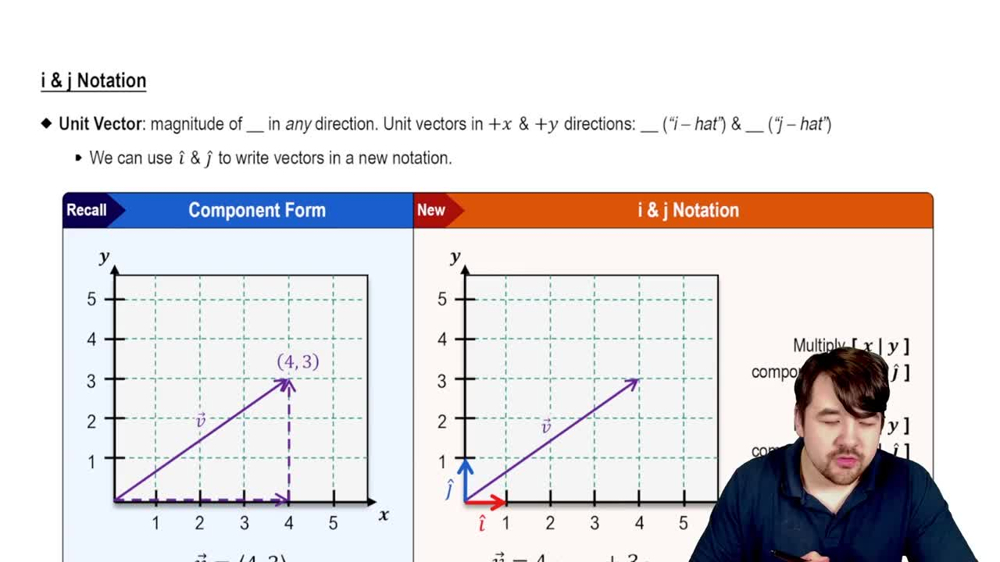
Vectors in two dimensions are represented as ordered pairs 〈x, y〉, where x and y are components along the horizontal and vertical axes. Understanding this notation is essential for performing operations like addition, subtraction, and scalar multiplication.
Basic vector operations include addition, subtraction, and scalar multiplication. These operations follow component-wise rules, allowing manipulation of vectors algebraically. Mastery of these operations is fundamental for solving vector-related problems.

 Verified step by step guidance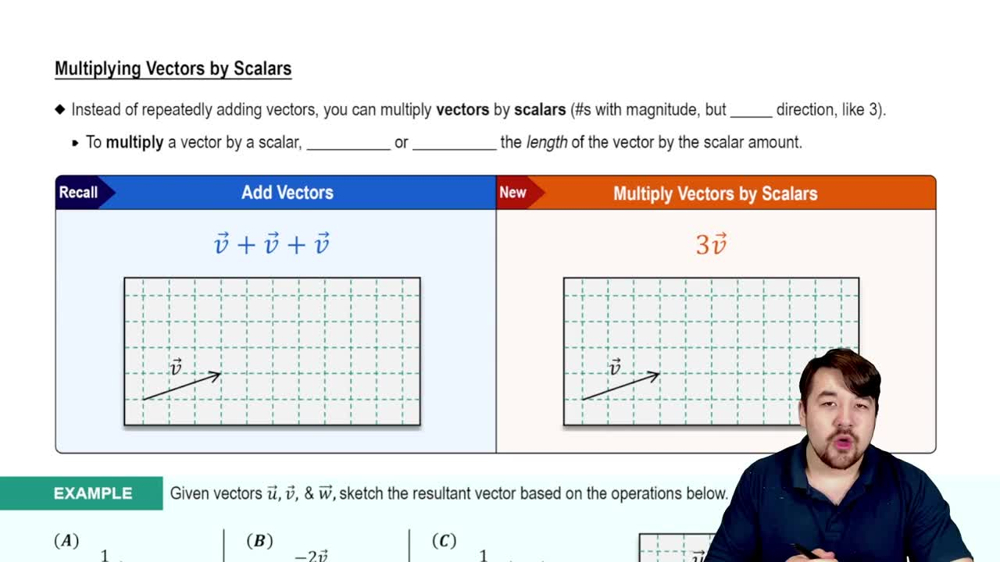
 05:05
05:05