Determine the amplitude of each function. Then graph the function and y = sin x in the same rectangular coordinate system for 0 ≤ x ≤ 2π. y = -3 sin x
Table of contents
- 0. Review of College Algebra4h 45m
- 1. Measuring Angles40m
- 2. Trigonometric Functions on Right Triangles2h 5m
- 3. Unit Circle1h 19m
- 4. Graphing Trigonometric Functions1h 19m
- 5. Inverse Trigonometric Functions and Basic Trigonometric Equations1h 41m
- 6. Trigonometric Identities and More Equations2h 34m
- 7. Non-Right Triangles1h 38m
- 8. Vectors2h 25m
- 9. Polar Equations2h 5m
- 10. Parametric Equations1h 6m
- 11. Graphing Complex Numbers1h 7m
4. Graphing Trigonometric Functions
Graphs of the Sine and Cosine Functions
Problem 13
Textbook Question
In Exercises 12–13, use a vertical shift to graph one period of the function. y = 2 cos 1/3 x − 2
Verified step by step guidance1
Identify the given function: \(y = 2 \cos\left(\frac{1}{3}x\right) - 2\). Notice it is a cosine function with amplitude, horizontal stretch/compression, and vertical shift.
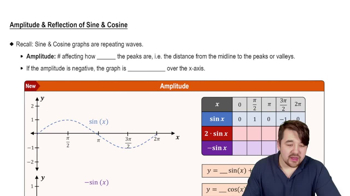
Determine the amplitude, which is the coefficient in front of the cosine: \(A = 2\). This means the graph will oscillate 2 units above and below its midline.
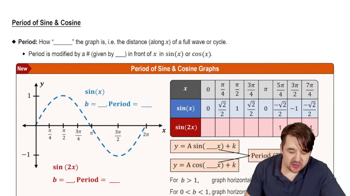
Find the period of the function using the formula for cosine period: \(\text{Period} = \frac{2\pi}{B}\), where \(B\) is the coefficient of \(x\) inside the cosine. Here, \(B = \frac{1}{3}\), so the period is \(\frac{2\pi}{\frac{1}{3}} = 6\pi\).
Identify the vertical shift, which is the constant added or subtracted outside the cosine function. Here, it is \(-2\), so the midline of the graph is shifted down 2 units from the \(x\)-axis.
To graph one period, start at \(x=0\) and plot points through one full period length \(6\pi\), adjusting the cosine values by multiplying by the amplitude and then shifting down by 2. The key points are at \(x=0\), \(x=\frac{6\pi}{4}\), \(x=\frac{6\pi}{2}\), \(x=\frac{3\cdot6\pi}{4}\), and \(x=6\pi\), corresponding to the cosine wave's maximum, zero, minimum, zero, and maximum again, all shifted vertically.
Verified video answer for a similar problem:This video solution was recommended by our tutors as helpful for the problem above
Video duration:
5mPlay a video:
0 Comments
Key Concepts
Here are the essential concepts you must grasp in order to answer the question correctly.
Vertical Shift in Trigonometric Functions
A vertical shift moves the entire graph of a function up or down without changing its shape. For y = 2 cos(1/3 x) - 2, the '-2' shifts the cosine graph down by 2 units, affecting the midline and range but not the period or amplitude.
Recommended video:
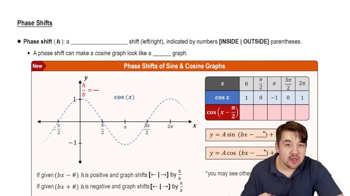
Phase Shifts
Period of a Cosine Function
The period of a cosine function y = cos(bx) is given by 2π divided by the absolute value of b. Here, with b = 1/3, the period is 2π / (1/3) = 6π, meaning one full cycle of the cosine wave spans 6π units along the x-axis.
Recommended video:
Period of Sine and Cosine Functions
Amplitude of a Cosine Function
Amplitude is the height from the midline to the peak of the wave and is the absolute value of the coefficient before cosine. In y = 2 cos(1/3 x) - 2, the amplitude is 2, indicating the graph oscillates 2 units above and below its midline.
Recommended video:
Amplitude and Reflection of Sine and Cosine
Related Videos
Related Practice
Textbook Question
1288
views