In Exercises 85–96, use a calculator to solve each equation, correct to four decimal places, on the interval [0, 2𝝅). cos x = ﹣ 2/5
Table of contents
- 0. Review of College Algebra4h 45m
- 1. Measuring Angles40m
- 2. Trigonometric Functions on Right Triangles2h 5m
- 3. Unit Circle1h 19m
- 4. Graphing Trigonometric Functions1h 19m
- 5. Inverse Trigonometric Functions and Basic Trigonometric Equations1h 41m
- 6. Trigonometric Identities and More Equations2h 34m
- 7. Non-Right Triangles1h 38m
- 8. Vectors2h 25m
- 9. Polar Equations2h 5m
- 10. Parametric Equations1h 6m
- 11. Graphing Complex Numbers1h 7m
5. Inverse Trigonometric Functions and Basic Trigonometric Equations
Linear Trigonometric Equations
Problem 95
Textbook Question
In Exercises 85–96, use a calculator to solve each equation, correct to four decimal places, on the interval [0, 2𝝅). 7 sin² x - 1 = 0
Verified step by step guidance1
Rewrite the equation to isolate the trigonometric function: start with the given equation \(7 \sin^{2} x - 1 = 0\) and add 1 to both sides to get \(7 \sin^{2} x = 1\).
Divide both sides by 7 to solve for \(\sin^{2} x\): \(\sin^{2} x = \frac{1}{7}\).
Take the square root of both sides to solve for \(\sin x\): \(\sin x = \pm \sqrt{\frac{1}{7}}\).
Use a calculator to find the principal values of \(x\) for \(\sin x = \sqrt{\frac{1}{7}}\) and \(\sin x = -\sqrt{\frac{1}{7}}\) within the interval \([0, 2\pi)\), remembering that sine is positive in the first and second quadrants and negative in the third and fourth quadrants.
List all solutions found from the calculator and express them as values of \(x\) in radians, rounded to four decimal places, ensuring all solutions lie within the interval \([0, 2\pi)\).
Verified video answer for a similar problem:This video solution was recommended by our tutors as helpful for the problem above
Video duration:
2mPlay a video:
0 Comments
Key Concepts
Here are the essential concepts you must grasp in order to answer the question correctly.
Solving Trigonometric Equations
Solving trigonometric equations involves finding all angle values within a specified interval that satisfy the given equation. This often requires algebraic manipulation to isolate the trigonometric function and then using inverse functions or known values to find solutions.
Recommended video:
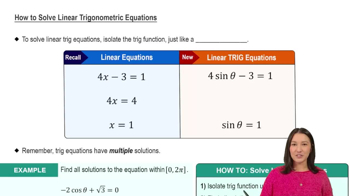
How to Solve Linear Trigonometric Equations
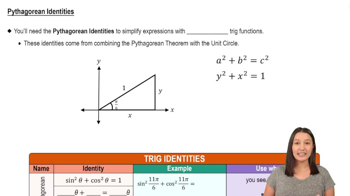
Using the Pythagorean Identity
The Pythagorean identity, sin²x + cos²x = 1, helps rewrite or simplify trigonometric expressions. In this problem, recognizing sin²x as (sin x)² allows for algebraic manipulation, such as treating sin²x as a variable squared, facilitating equation solving.
Recommended video:
Pythagorean Identities
Calculator Use and Radian Measure
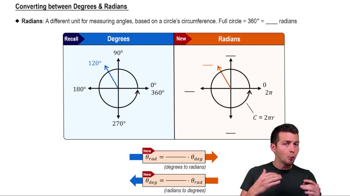
Using a calculator to solve trigonometric equations requires setting it to radian mode when working on intervals like [0, 2π). Calculators help find inverse trigonometric values and approximate solutions to the desired decimal accuracy, here correct to four decimal places.
Recommended video:
Converting between Degrees & Radians
Related Videos
Related Practice
Textbook Question
433
views