In Exercises 85–96, use a calculator to solve each equation, correct to four decimal places, on the interval [0, 2𝝅). 4 tan² x - 8 tan x + 3 = 0
Table of contents
- 0. Review of College Algebra4h 45m
- 1. Measuring Angles40m
- 2. Trigonometric Functions on Right Triangles2h 5m
- 3. Unit Circle1h 19m
- 4. Graphing Trigonometric Functions1h 19m
- 5. Inverse Trigonometric Functions and Basic Trigonometric Equations1h 41m
- 6. Trigonometric Identities and More Equations2h 34m
- 7. Non-Right Triangles1h 38m
- 8. Vectors2h 25m
- 9. Polar Equations2h 5m
- 10. Parametric Equations1h 6m
- 11. Graphing Complex Numbers1h 7m
5. Inverse Trigonometric Functions and Basic Trigonometric Equations
Linear Trigonometric Equations
Problem 3.RE.50
Textbook Question
In Exercises 50–53, find all solutions of each equation. cos x = ﹣1/2
Verified step by step guidance1
Recognize that the equation is \(\cos x = -\frac{1}{2}\). We need to find all angles \(x\) where the cosine value is \(-\frac{1}{2}\).
Recall the unit circle values where \(\cos x = \pm \frac{1}{2}\). Specifically, \(\cos x = \frac{1}{2}\) at \(x = \frac{\pi}{3}\) and \(x = \frac{5\pi}{3}\), so for \(\cos x = -\frac{1}{2}\), the solutions will be in the second and third quadrants.
Identify the reference angle \(\theta\) such that \(\cos \theta = \frac{1}{2}\). This reference angle is \(\theta = \frac{\pi}{3}\).
Write the general solutions for \(\cos x = -\frac{1}{2}\) using the reference angle and the fact that cosine is negative in the second and third quadrants: \(x = \pi - \frac{\pi}{3} + 2k\pi\) and \(x = \pi + \frac{\pi}{3} + 2k\pi\), where \(k\) is any integer.
Simplify the expressions to get \(x = \frac{2\pi}{3} + 2k\pi\) and \(x = \frac{4\pi}{3} + 2k\pi\). These represent all solutions to the equation \(\cos x = -\frac{1}{2}\).
Verified video answer for a similar problem:This video solution was recommended by our tutors as helpful for the problem above
Video duration:
3mPlay a video:
0 Comments
Key Concepts
Here are the essential concepts you must grasp in order to answer the question correctly.
Basic Trigonometric Equations
Solving trigonometric equations involves finding all angles x that satisfy the given equation within a specified domain. For example, solving cos x = -1/2 means identifying all angles where the cosine value equals -0.5, considering the periodic nature of cosine.
Recommended video:
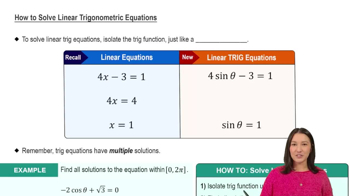
How to Solve Linear Trigonometric Equations
Unit Circle and Reference Angles
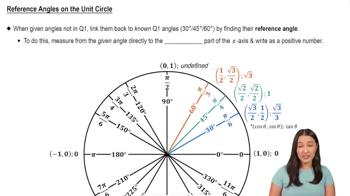
The unit circle helps visualize cosine values as the x-coordinate of points on the circle. To solve cos x = -1/2, one finds the reference angle where cosine is 1/2 and then determines the angles in the appropriate quadrants where cosine is negative (second and third quadrants).
Recommended video:
Reference Angles on the Unit Circle
General Solution for Cosine Equations
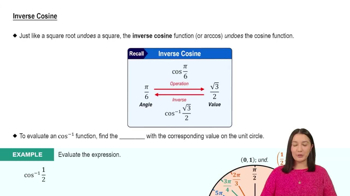
Because cosine is periodic with period 2π, the general solutions for cos x = a are x = ±θ + 2kπ, where θ is the reference angle and k is any integer. This accounts for all possible solutions over the real numbers.
Recommended video:
Inverse Cosine
Related Videos
Related Practice
Textbook Question
412
views