In Exercises 85–96, use a calculator to solve each equation, correct to four decimal places, on the interval [0, 2𝝅). tan x = ﹣3
Table of contents
- 0. Review of College Algebra4h 45m
- 1. Measuring Angles40m
- 2. Trigonometric Functions on Right Triangles2h 5m
- 3. Unit Circle1h 19m
- 4. Graphing Trigonometric Functions1h 19m
- 5. Inverse Trigonometric Functions and Basic Trigonometric Equations1h 41m
- 6. Trigonometric Identities and More Equations2h 34m
- 7. Non-Right Triangles1h 38m
- 8. Vectors2h 25m
- 9. Polar Equations2h 5m
- 10. Parametric Equations1h 6m
- 11. Graphing Complex Numbers1h 7m
5. Inverse Trigonometric Functions and Basic Trigonometric Equations
Linear Trigonometric Equations
Problem 127
Textbook Question
In Exercises 127–130, solve each equation on the interval [0, 2𝝅) by first rewriting the equation in terms of sines or cosines. csc² x + csc x - 2 = 0
Verified step by step guidance1
Start by rewriting the given equation in terms of sine, since \( \csc x = \frac{1}{\sin x} \). The equation is \( \csc^2 x + \csc x - 2 = 0 \), so substitute to get \( \frac{1}{\sin^2 x} + \frac{1}{\sin x} - 2 = 0 \).
To simplify, multiply the entire equation by \( \sin^2 x \) (noting that \( \sin x \neq 0 \) in the domain) to clear the denominators: \( 1 + \sin x - 2 \sin^2 x = 0 \).
Rewrite the equation in standard quadratic form in terms of \( \sin x \): \( -2 \sin^2 x + \sin x + 1 = 0 \). For easier handling, multiply both sides by \( -1 \) to get \( 2 \sin^2 x - \sin x - 1 = 0 \).
Let \( y = \sin x \). Now solve the quadratic equation \( 2y^2 - y - 1 = 0 \) using the quadratic formula \( y = \frac{-b \pm \sqrt{b^2 - 4ac}}{2a} \), where \( a=2 \), \( b=-1 \), and \( c=-1 \).
After finding the values of \( y \), determine which solutions lie within the range \( [-1, 1] \) since \( \sin x \) must be in this interval. Then, find all \( x \) in \( [0, 2\pi) \) such that \( \sin x = y \).
Verified video answer for a similar problem:This video solution was recommended by our tutors as helpful for the problem above
Video duration:
6mPlay a video:
0 Comments
Key Concepts
Here are the essential concepts you must grasp in order to answer the question correctly.
Reciprocal Trigonometric Functions
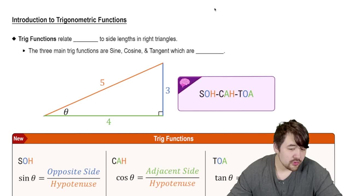
The cosecant function (csc x) is the reciprocal of sine, defined as csc x = 1/sin x. Understanding this relationship allows rewriting equations involving csc x in terms of sin x, which is often easier to solve.
Recommended video:
Introduction to Trigonometric Functions
Solving Quadratic Equations in Trigonometric Form
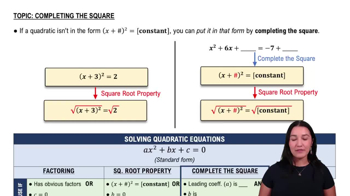
Equations like csc² x + csc x - 2 = 0 can be treated as quadratic equations by substituting a trigonometric function (e.g., csc x = y). Solving the quadratic for y and then reverting to the trigonometric function helps find the solutions.
Recommended video:
Solving Quadratic Equations by Completing the Square
Solving Trigonometric Equations on a Specific Interval
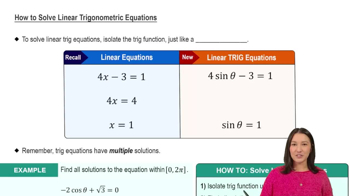
When solving trigonometric equations on [0, 2π), it is important to find all solutions within one full cycle of the unit circle. This involves considering the periodicity and domain restrictions of sine and cosecant functions.
Recommended video:
How to Solve Linear Trigonometric Equations
Related Videos
Related Practice
Textbook Question
428
views