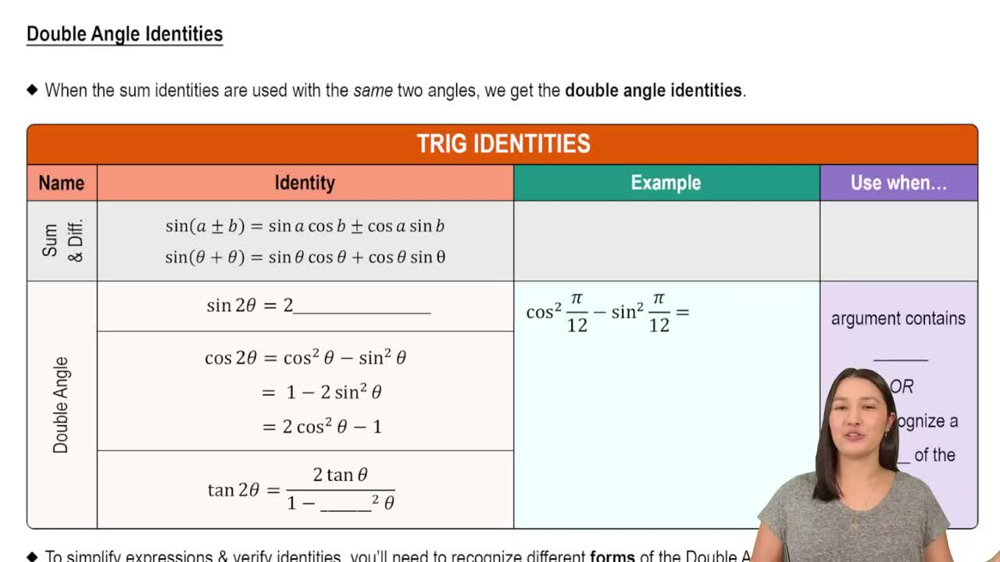
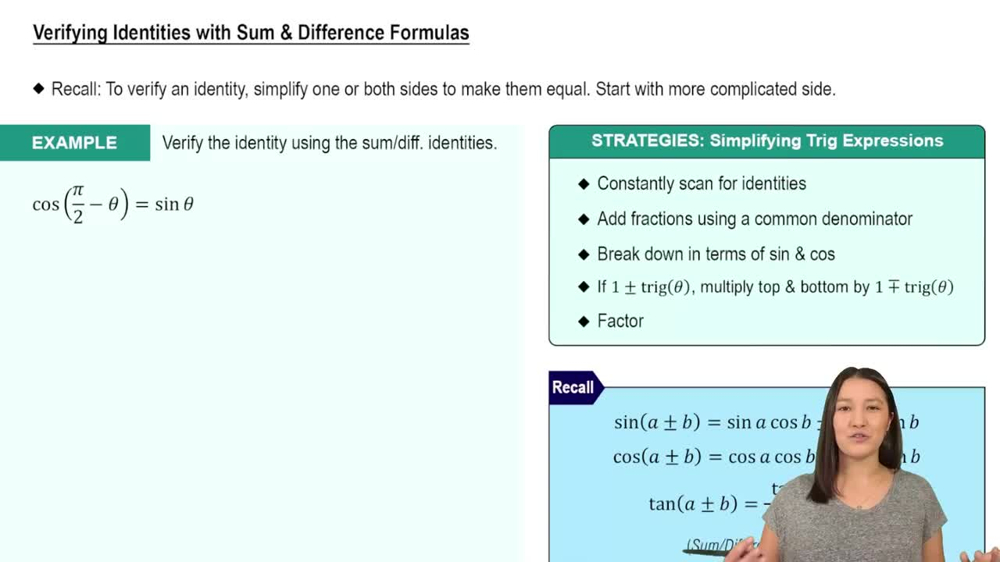
Verify that each equation is an identity (Hint: cos 2x = cos(x + x).) cos 2x = cos² x - sin² x
Verified step by step guidance
1
Start by recognizing the given hint: express \( \cos 2x \) as \( \cos(x + x) \). This allows you to use the cosine addition formula.
Recall the cosine addition formula: \( \cos(a + b) = \cos a \cos b - \sin a \sin b \). Substitute \( a = x \) and \( b = x \) to get \( \cos 2x = \cos x \cos x - \sin x \sin x \).
Simplify the right-hand side by writing \( \cos x \cos x \) as \( \cos^2 x \) and \( \sin x \sin x \) as \( \sin^2 x \), resulting in \( \cos 2x = \cos^2 x - \sin^2 x \).
Compare this expression with the right side of the original equation \( \cos 2x = \cos^2 x - \sin^2 x \) to see that both sides are identical.
Conclude that the equation is an identity because it holds true for all values of \( x \) where the functions are defined.
Verified video answer for a similar problem:
This video solution was recommended by our tutors as helpful for the problem above
Play a video:
0 Comments
Key Concepts
Here are the essential concepts you must grasp in order to answer the question correctly.
Trigonometric Identities
Trigonometric identities are equations involving trigonometric functions that hold true for all values within their domains. They are used to simplify expressions and prove equivalences, such as the double-angle formulas, which relate functions of multiple angles to functions of single angles.
The double-angle formula for cosine expresses cos(2x) in terms of cos(x) and sin(x). It can be written as cos(2x) = cos²(x) - sin²(x), which is derived from the sum formula cos(a + b) = cos a cos b - sin a sin b by setting a = b = x.
The sum formula for cosine states that cos(a + b) = cos a cos b - sin a sin b. This formula is fundamental for deriving other identities, including the double-angle formula, by substituting specific angle values and simplifying the resulting expressions.

 Verified step by step guidance
 5:32
5:32