Verify that each equation is an identity (Hint: cos 2x = cos(x + x).) cos 2x = 1 - 2 sin² x
Verified step by step guidance
1
Start by expressing \( \cos 2x \) using the angle addition formula for cosine: \( \cos(a + b) = \cos a \cos b - \sin a \sin b \). Since \( 2x = x + x \), write \( \cos 2x = \cos x \cos x - \sin x \sin x \).
Simplify the expression to get \( \cos 2x = \cos^2 x - \sin^2 x \). This is one of the standard double-angle formulas for cosine.
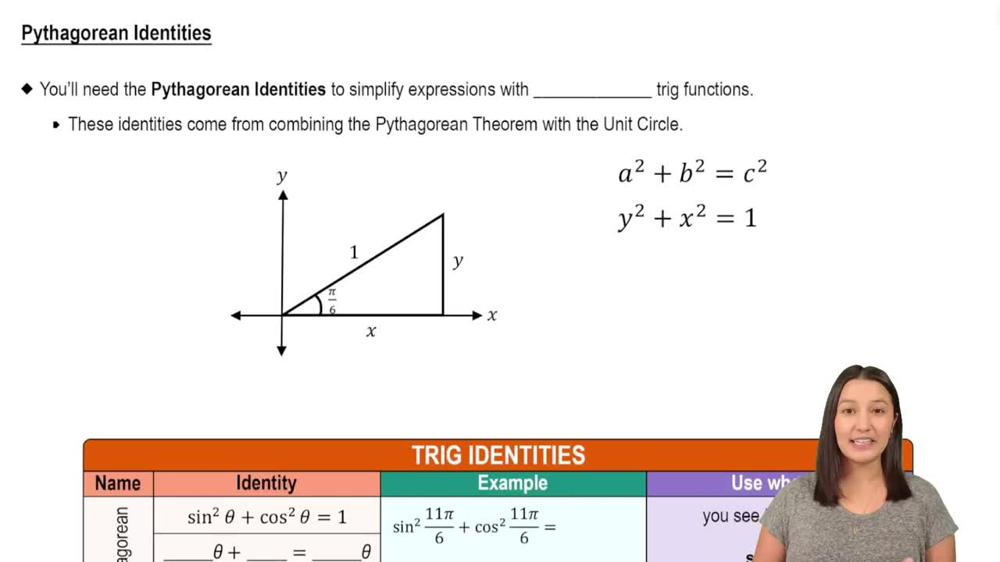
Recall the Pythagorean identity \( \sin^2 x + \cos^2 x = 1 \). Use this to rewrite \( \cos^2 x \) in terms of \( \sin^2 x \): \( \cos^2 x = 1 - \sin^2 x \).
Substitute \( \cos^2 x = 1 - \sin^2 x \) into the expression \( \cos 2x = \cos^2 x - \sin^2 x \) to get \( \cos 2x = (1 - \sin^2 x) - \sin^2 x \).
Simplify the right-hand side to obtain \( \cos 2x = 1 - 2 \sin^2 x \), which matches the given identity, thus verifying it.
Verified video answer for a similar problem:
This video solution was recommended by our tutors as helpful for the problem above
Play a video:
0 Comments
Key Concepts
Here are the essential concepts you must grasp in order to answer the question correctly.
Double-Angle Identity for Cosine
The double-angle identity expresses cos 2x in terms of functions of x. It can be written as cos 2x = cos² x - sin² x, or equivalently as cos 2x = 1 - 2 sin² x. This identity helps simplify expressions involving angles multiplied by two.
The Pythagorean identity states that sin² x + cos² x = 1 for any angle x. This fundamental relationship allows substitution between sine and cosine squared terms, which is essential when verifying or transforming trigonometric identities.
Verifying an identity involves showing that both sides of an equation are equivalent for all values of the variable. This often requires algebraic manipulation using known identities, such as the double-angle and Pythagorean identities, to rewrite one side to match the other.

 Verified step by step guidance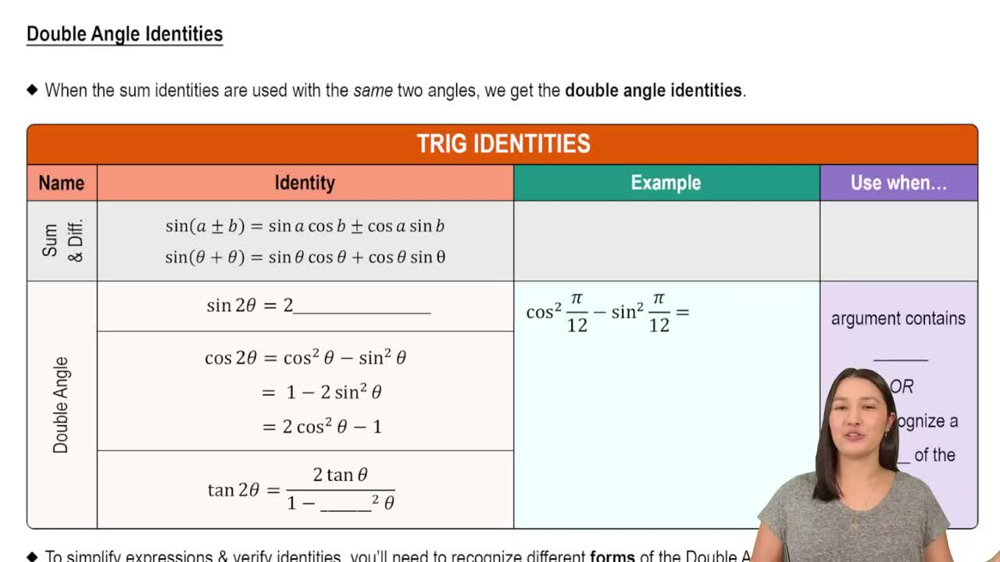
 05:06
05:06