Find the exact value of each expression. Write the answer as a single fraction. Do not use a calculator. sin (3𝜋/2) tan (-15𝜋/4) - cos (-5𝜋/3)
Verified step by step guidance
1
First, simplify each trigonometric function by reducing the angles to their equivalent angles within the standard interval \([0, 2\pi)\) or \([-\pi, \pi)\) using the periodicity of sine, cosine, and tangent functions. For example, use the fact that \(\sin(\theta)\) and \(\cos(\theta)\) have period \(2\pi\), and \(\tan(\theta)\) has period \(\pi\).
Calculate \(\sin 3\pi\) by recognizing that \(3\pi\) is equivalent to \(\pi\) plus \(2\pi\), so use the periodicity of sine: \(\sin(3\pi) = \sin(\pi)\).
Simplify \(\tan(-15\pi/4)\) by adding or subtracting multiples of \(\pi\) to bring the angle within the principal period of tangent, which is \(\pi\). For example, add \(4\pi\) (which is \(16\pi/4\)) to \(-15\pi/4\) to get an equivalent positive angle.
Simplify \(\cos(-5\pi/3)\) by using the even property of cosine, \(\cos(-\theta) = \cos(\theta)\), and then reduce the angle \(5\pi/3\) to an equivalent angle within \([0, 2\pi)\) if necessary.
After finding the exact values of \(\sin 3\pi\), \(\tan(-15\pi/4)\), and \(\cos(-5\pi/3)\), substitute them back into the expression \(\sin 3\pi \tan(-15\pi/4) - \cos(-5\pi/3)\), and then write the result as a single fraction without using a calculator.
Verified video answer for a similar problem:
This video solution was recommended by our tutors as helpful for the problem above
Video duration:
6m
Play a video:
0 Comments
Key Concepts
Here are the essential concepts you must grasp in order to answer the question correctly.
Unit Circle and Angle Measurement
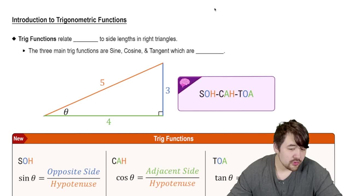
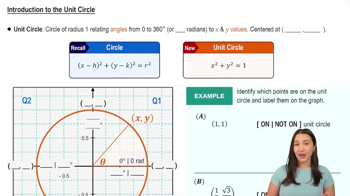
The unit circle is a fundamental tool for understanding trigonometric functions. Angles are measured in radians, and knowing how to find equivalent angles within one full rotation (0 to 2π) helps simplify expressions involving large or negative angles.
Certain angles, such as π/3, π/4, and π/6, have well-known sine, cosine, and tangent values. Recognizing these special angles and their exact trigonometric values allows for precise calculation without a calculator.
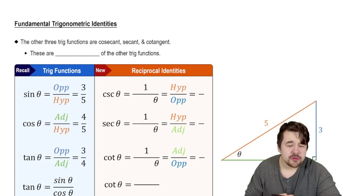
Using identities like angle addition formulas, periodicity, and even-odd properties of sine, cosine, and tangent helps simplify complex expressions. This is essential for combining terms and expressing the final answer as a single fraction.

 6:59 minutes
 Verified step by step guidance
 06:11
06:11