Find exact values of the six trigonometric functions for each angle. Do not use a calculator. Rationalize denominators when applicable. 120°
Table of contents
- 0. Review of College Algebra4h 45m
- 1. Measuring Angles40m
- 2. Trigonometric Functions on Right Triangles2h 5m
- 3. Unit Circle1h 19m
- 4. Graphing Trigonometric Functions1h 19m
- 5. Inverse Trigonometric Functions and Basic Trigonometric Equations1h 41m
- 6. Trigonometric Identities and More Equations2h 34m
- 7. Non-Right Triangles1h 38m
- 8. Vectors2h 25m
- 9. Polar Equations2h 5m
- 10. Parametric Equations1h 6m
- 11. Graphing Complex Numbers1h 7m
3. Unit Circle
Trigonometric Functions on the Unit Circle
Problem 2.3.60
Textbook Question
Use a calculator to determine whether each statement is true or false. A true statement may lead to results that differ in the last decimal place due to rounding error. tan² 72°25' + 1 = sec² 72°25'
Verified step by step guidance1
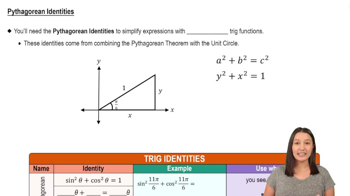
First, recognize the Pythagorean identity involving tangent and secant: \(\tan^2 \theta + 1 = \sec^2 \theta\). This identity holds true for any angle \(\theta\) where these functions are defined.
Convert the angle from degrees and minutes to decimal degrees for calculator input. Since 1 minute is \(\frac{1}{60}\) degrees, calculate \(72°25' = 72 + \frac{25}{60}\) degrees.
Calculate \(\tan(72.4167°)\) using the calculator, then square the result to find \(\tan^2(72.4167°)\).
Add 1 to the value obtained in the previous step to compute \(\tan^2(72.4167°) + 1\).
Calculate \(\sec(72.4167°)\) by finding \(\frac{1}{\cos(72.4167°)}\) using the calculator, then square this value to get \(\sec^2(72.4167°)\). Finally, compare this result with the value from step 4 to determine if the statement is true or false, considering minor differences due to rounding.
Verified video answer for a similar problem:This video solution was recommended by our tutors as helpful for the problem above
Video duration:
2mPlay a video:
0 Comments
Key Concepts
Here are the essential concepts you must grasp in order to answer the question correctly.
Pythagorean Identity for Tangent and Secant
The identity tan²θ + 1 = sec²θ is a fundamental trigonometric identity derived from the Pythagorean theorem. It relates the square of the tangent of an angle to the square of the secant of the same angle, holding true for all angles where these functions are defined.
Recommended video:
Pythagorean Identities
Angle Conversion and Notation
Angles given in degrees and minutes (e.g., 72°25') must be converted to decimal degrees or radians for calculator use. One minute equals 1/60 of a degree, so 72°25' equals 72 + 25/60 degrees, ensuring accurate input for trigonometric calculations.
Recommended video:
i & j Notation
Rounding Errors in Calculator Computations
Calculators approximate trigonometric values, which can cause minor differences in the last decimal places. Understanding that slight discrepancies do not invalidate identities is important when verifying trigonometric statements numerically.
Recommended video:
Computing the Cross Product
Related Videos
Related Practice
Textbook Question
743
views