The graph of a tangent function is given. Select the equation for each graph from the following options: y = tan(x + π/2), y = tan(x + π), y= -tan x, y = −tan(x − π/2).
Table of contents
- 0. Review of College Algebra4h 45m
- 1. Measuring Angles40m
- 2. Trigonometric Functions on Right Triangles2h 5m
- 3. Unit Circle1h 19m
- 4. Graphing Trigonometric Functions1h 19m
- 5. Inverse Trigonometric Functions and Basic Trigonometric Equations1h 41m
- 6. Trigonometric Identities and More Equations2h 34m
- 7. Non-Right Triangles1h 38m
- 8. Vectors2h 25m
- 9. Polar Equations2h 5m
- 10. Parametric Equations1h 6m
- 11. Graphing Complex Numbers1h 7m
2. Trigonometric Functions on Right Triangles
Solving Right Triangles
Problem 9
Textbook Question
Graph two periods of the given tangent function. y = −2 tan (1/2) x
Verified step by step guidance1
Identify the general form of the tangent function: \(y = a \tan(bx)\), where \(a\) affects the amplitude (vertical stretch) and \(b\) affects the period of the function.
Determine the period of the function using the formula for tangent: \(\text{Period} = \frac{\pi}{|b|}\). Here, \(b = \frac{1}{2}\), so calculate the period as \(\frac{\pi}{\frac{1}{2}}\).
Calculate the period explicitly: \(\frac{\pi}{\frac{1}{2}} = 2\pi\). This means one full cycle of the tangent function occurs over an interval of length \(2\pi\).
Since the problem asks for two periods, plan to graph the function over an interval of length \(2 \times 2\pi = 4\pi\). This will cover two full cycles of the tangent function.
Note the vertical stretch and reflection: the coefficient \(-2\) means the graph is vertically stretched by a factor of 2 and reflected across the x-axis. Use this to sketch the graph accordingly, marking key points such as vertical asymptotes where the tangent function is undefined.
Verified video answer for a similar problem:This video solution was recommended by our tutors as helpful for the problem above
Video duration:
8mPlay a video:
0 Comments
Key Concepts
Here are the essential concepts you must grasp in order to answer the question correctly.
Period of the Tangent Function
The period of the basic tangent function y = tan(x) is π. When the function is transformed to y = tan(bx), the period changes to π divided by the absolute value of b. Understanding this helps determine the length of one full cycle to graph two periods accurately.
Recommended video:
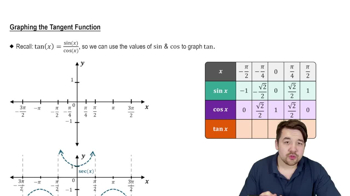
Introduction to Tangent Graph
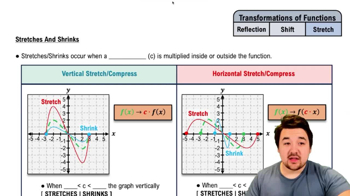
Amplitude and Vertical Stretch
Although tangent functions do not have a maximum amplitude, the coefficient outside the function, such as -2 in y = -2 tan(½x), vertically stretches the graph by a factor of 2 and reflects it across the x-axis. This affects the steepness and direction of the graph's slopes.
Recommended video:
Stretches and Shrinks of Functions
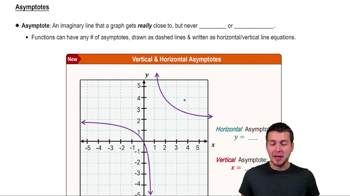
Asymptotes of the Tangent Function
Tangent functions have vertical asymptotes where the function is undefined, occurring at x-values where the cosine is zero. For y = tan(bx), asymptotes occur at x = (π/2 + kπ)/b. Identifying these asymptotes is essential for correctly sketching the graph.
Recommended video:
Asymptotes
Related Videos
Related Practice
Textbook Question
1029
views