In Exercises 33–38, find projᵥᵥ v. Then decompose v into two vectors, v₁ and v₂, where v₁ is parallel to w and v₂ is orthogonal to w. v = i + 3j, w = -2i + 5j
Verified step by step guidance
1
Identify the vectors \( \mathbf{v} = \mathbf{i} + 3\mathbf{j} \) and \( \mathbf{w} = -2\mathbf{i} + 5\mathbf{j} \). Write them in component form as \( \mathbf{v} = (1, 3) \) and \( \mathbf{w} = (-2, 5) \).
Calculate the projection of \( \mathbf{v} \) onto \( \mathbf{w} \) using the formula:
\[
\text{proj}_{\mathbf{w}} \mathbf{v} = \left( \frac{\mathbf{v} \cdot \mathbf{w}}{\mathbf{w} \cdot \mathbf{w}} \right) \mathbf{w}
\]
where \( \mathbf{v} \cdot \mathbf{w} \) is the dot product of \( \mathbf{v} \) and \( \mathbf{w} \), and \( \mathbf{w} \cdot \mathbf{w} \) is the dot product of \( \mathbf{w} \) with itself.
Substitute the dot product values into the projection formula to find \( \text{proj}_{\mathbf{w}} \mathbf{v} \). This gives you the vector \( \mathbf{v}_1 \) which is parallel to \( \mathbf{w} \).
Find the vector \( \mathbf{v}_2 \), which is orthogonal to \( \mathbf{w} \), by subtracting the projection from \( \mathbf{v} \):
\[
\mathbf{v}_2 = \mathbf{v} - \mathbf{v}_1
\]
This completes the decomposition of \( \mathbf{v} \) into \( \mathbf{v}_1 \) (parallel to \( \mathbf{w} \)) and \( \mathbf{v}_2 \) (orthogonal to \( \mathbf{w} \)).
Verified video answer for a similar problem:
This video solution was recommended by our tutors as helpful for the problem above
Video duration:
6m
Play a video:
0 Comments
Key Concepts
Here are the essential concepts you must grasp in order to answer the question correctly.
Vector Projection
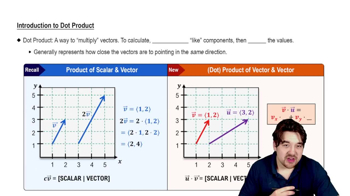
Vector projection of v onto w, denoted proj_w v, is the component of v that points in the direction of w. It is calculated using the dot product as (v · w / ||w||²) times the vector w. This concept helps in finding how much of one vector lies along another.
The dot product of two vectors is a scalar representing their directional similarity. It is computed as the sum of the products of their corresponding components. The dot product is essential for calculating projections and determining orthogonality between vectors.
Vector decomposition involves expressing a vector as the sum of two components: one parallel to a given vector and one orthogonal to it. Here, v is decomposed into v₁ (parallel to w) and v₂ (orthogonal to w), where v₁ = proj_w v and v₂ = v - v₁. This technique is useful in many applications like resolving forces.

 6:38 minutes
 Verified step by step guidance
 03:48
03:48