Back
Back
Problem 61
Evaluate each expression. See Example 5. -|4.5|
Problem 63
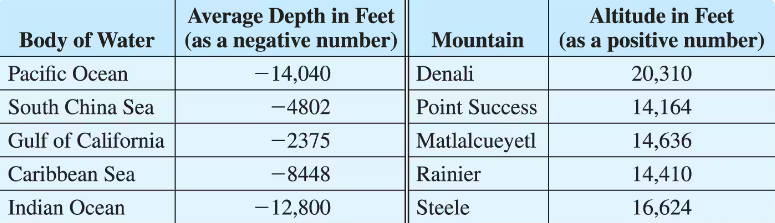
Sea level refers to the surface of the ocean. The depth of a body of water can be expressed as a negative number, representing average depth in feet below sea level. The altitude of a mountain can be expressed as a positive number, indicating its height in feet above sea level. The table gives selected depths and altitudes. List the bodies of water in order, deepest to shallowest.
Problem 67
Use a number line to determine whether each statement is true or false. See Example 6. -6 < -1
Problem 69
Use a number line to determine whether each statement is true or false. -4 > -3
Problem 71
Use a number line to determine whether each statement is true or false. 3 > -2
Problem 73
Use a number line to determine whether each statement is true or false. -3 > -3
Problem 75
Rewrite each statement with > so that it uses < instead. Rewrite each statement with < so that it uses >. See Example 6. 6 > 2
Problem 77
Rewrite each statement with > so that it uses < instead. Rewrite each statement with < so that it uses >. -9 < 4
Problem 79
Rewrite each statement with > so that it uses < instead. Rewrite each statement with < so that it uses >. -5 > -100
Problem 81
Use an inequality symbol to write each statement. 7 is greather than -1.
Problem 83
Use an inequality symbol to write each statement. 5 is greater than or equal to 5.
Problem 85
Use an inequality symbol to write each statement. 13 - 3 is less than or equal to 10.
Problem 87
Use an inequality symbol to write each statement. 5 + 0 is not equal to 0.
Problem 89
Simplify each inequality if needed. Then determine whether the statement is true or false. 0 ≤ -5
Problem 93
Simplify each inequality if needed. Then determine whether the statement is true or false. -6 < 7 + 3
Problem 95
Simplify each inequality if needed. Then determine whether the statement is true or false. 2 • 5 ≥ 4 + 6
Problem 97
Simplify each inequality if needed. Then determine whether the statement is true or false. -|-3| ≥ -3
Problem 99
Simplify each inequality if needed. Then determine whether the statement is true or false. -8 > -|-6|
Problem R.2.71
Evaluate each expression. See Example 4. -2⁴
Problem R.2.53
Find each product or quotient where possible. See Example 2. 5/0
Problem R.2.59
Find each product or quotient where possible. See Example 2. (12⁄13)/( -4⁄3)
Problem R.2.85
Evaluate each expression. See Example 5. 10 + 30 ÷ 2 • 3
Problem R.2.55
Find each product or quotient where possible. See Example 2. -10⁄17 ÷ ( -12⁄5 )
Problem R.2.135
Simplify each expression. See Example 8. -12y + 4y + 3y + 2y
Problem R.2.127
Rewrite each expression using the distributive property and simplify, if possible. See Example 7. a + 7a
Problem R.2.73
Evaluate each expression. See Example 4. (-2)⁴
Problem R.2.115
Identify the property illustrated in each statement. Assume all variables represent real numbers. 5 + √3 is a real number.
Problem R.2.57
Find each product or quotient where possible. See Example 2. (-4⁄5) / (-3⁄5)
Problem R.2.103
Evaluate each expression for p = -4, q = 8, and r = -10. See Example 6. (-(p + 2)² - 3r)/(2 - q)
Problem R.2.133
Rewrite each expression using the distributive property and simplify, if possible. See Example 7. 3/8 ( 16/9 y + 32/27 z - 40/9 )