After glucose is fully oxidized by glycolysis, pyruvate processing, and the citric acid cycle, where is most of its energy stored?
Verified step by step guidance
1
Understand that glucose oxidation involves glycolysis, pyruvate processing, and the citric acid cycle.
Recognize that during these processes, glucose is broken down and its energy is transferred to electron carriers.
Identify the main electron carriers involved: NADH and FADH2.
Acknowledge that these electron carriers store the majority of the energy from glucose oxidation.
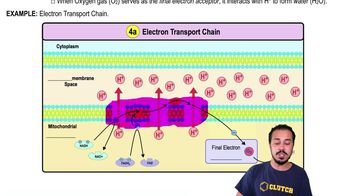
Note that NADH and FADH2 will later donate electrons to the electron transport chain, where the energy will be used to produce ATP.
Verified video answer for a similar problem:
This video solution was recommended by our tutors as helpful for the problem above
Video duration:
1m
Play a video:
0 Comments
Key Concepts
Here are the essential concepts you must grasp in order to answer the question correctly.
Glycolysis
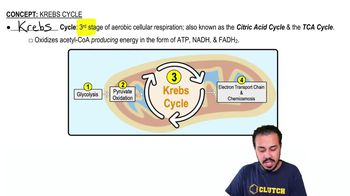
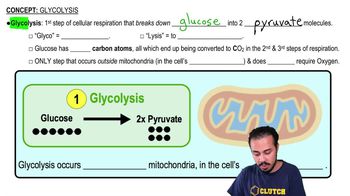
Glycolysis is the metabolic pathway that converts glucose into pyruvate, producing a small amount of ATP and NADH in the process. It occurs in the cytoplasm and is the first step in cellular respiration, setting the stage for further energy extraction from glucose.
The Citric Acid Cycle, also known as the Krebs cycle, is a series of chemical reactions that take place in the mitochondria. It processes acetyl-CoA derived from pyruvate, generating high-energy electron carriers (NADH and FADH2) and releasing carbon dioxide, which is crucial for energy production.
The Electron Transport Chain (ETC) is a series of protein complexes located in the inner mitochondrial membrane. It utilizes the high-energy electrons from NADH and FADH2 to create a proton gradient, ultimately leading to the production of ATP through oxidative phosphorylation, where most of the energy from glucose is stored.