Textbook Question
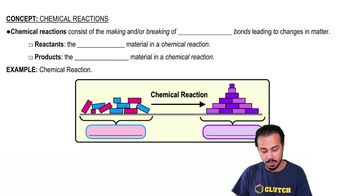
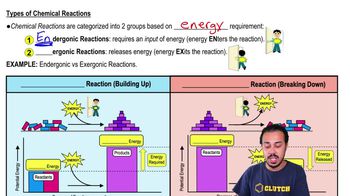
All the chemical reactions that occur in the human body are collectively referred to as
(a) Anabolism
(b) Catabolism
(c) Metabolism
(d) Homeostasis
36
views

 Martini, Nath, Bartholomew 11th EditionCh. 2 The Chemical Level of OrganizationProblem 9
 Verified step by step guidance
 01:56
01:56
 05:48 05:48
All the chemical reactions that occur in the human body are collectively referred to as
(a) Anabolism
(b) Catabolism
(c) Metabolism
(d) Homeostasis
A substance containing atoms of different elements that are bonded together is called a(n)
(a) Molecule
(b) Compound
(c) Mixture
(d) Isotope
(e) Solution
All organic compounds in the human body contain all of the following elements except
(a) Hydrogen
(b) Oxygen
(c) Carbon
(d) Calcium
(e) Both a and d
The speed, or rate, of a chemical reaction is influenced by
(a) The presence of catalysts
(b) The temperature
(c) The concentration of the reactants
(d) a, b, and c are all correct
A(n)__is a solute that dissociates to release hydrogen ions, and a(n)___is a solute that removes hydrogen ions from solution.
(a) base, acid
(b) salt, base
(c) acid, salt
(d) acid, base
A pH of 7.8 in the human body typifies a condition referred to as
(a) Acidosis
(b) Alkalosis
(c) Dehydration
(d) Homeostasis