 Back
BackGlycolysis: Pathway, Energy Yield, and Metabolic Fates
Study Guide - Smart Notes
 Tailored notes based on your materials, expanded with key definitions, examples, and context.
Glycolysis
Overview of Glycolysis
Glycolysis is the major anaerobic catabolic pathway for the breakdown of carbohydrates, specifically glucose, in nearly all living organisms. This pathway is highly conserved and has been extensively studied in yeast, bacteria, and mammals. Glycolysis occurs in the cytosol and consists of 10 sequential enzyme-catalyzed reactions, which can be grouped into two main stages:
Stage 1: Glucose is trapped and destabilized, preparing it for cleavage.
Stage 2: Generation of two three-carbon molecules, leading to the formation of pyruvate, ATP, and NADH.
Glycolysis is essential for energy production, especially under anaerobic conditions where oxygen is limited.
Net Reaction of Glycolysis
The overall chemical equation for glycolysis is as follows:
Reactants: Glucose, 2 ADP, 2 NAD+, 2 inorganic phosphate (Pi)
Products: 2 Pyruvate, 2 ATP, 2 NADH, 2 H+, 2 H2O
This process yields a net gain of 2 ATP molecules per glucose molecule metabolized.
Entry of Other Sugars into Glycolysis
Other dietary sugars can enter the glycolytic pathway after conversion to glycolytic intermediates:
Fructose: Derived from the hydrolysis of sucrose by sucrase. Fructose is converted to either fructose-1-phosphate or fructose-6-phosphate before entering glycolysis. The energy yield is the same as glucose, producing a net of 2 ATP per fructose molecule.
Galactose: Obtained from the hydrolysis of lactose by lactase. Galactose is converted to glucose-6-phosphate to enter glycolysis, also yielding 2 ATP per galactose molecule. Disorders such as lactose intolerance and galactosemia are related to defects in these metabolic steps.
Mannose: Sourced from dietary glycoproteins. Mannose is converted to fructose-6-phosphate and enters glycolysis, with the same net ATP yield as glucose.
Example: In individuals with lactose intolerance, the inability to hydrolyze lactose prevents galactose from entering glycolysis, leading to gastrointestinal symptoms.
Fates of Pyruvate
Pyruvate, the end product of glycolysis, has several metabolic fates depending on the organism and the presence or absence of oxygen:
Anaerobic (Yeast): Pyruvate is converted to acetaldehyde and then to ethanol (alcoholic fermentation).
Anaerobic (Mammals): Pyruvate is reduced to lactate (lactic acid fermentation), which occurs in muscle cells during intense exercise.
Aerobic (All Organisms): Pyruvate is transported into mitochondria and converted to acetyl-CoA, which enters the citric acid cycle for further oxidation and energy production.
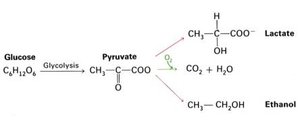
Example: During vigorous exercise, muscle cells rely on anaerobic glycolysis, leading to lactate accumulation and muscle fatigue.
Summary Table: Entry of Common Sugars into Glycolysis
Sugar | Source | Entry Point in Glycolysis | Net ATP Yield |
|---|---|---|---|
Glucose | Dietary carbohydrates | Glucose | 2 ATP |
Fructose | Hydrolysis of sucrose | Fructose-1-phosphate or Fructose-6-phosphate | 2 ATP |
Galactose | Hydrolysis of lactose | Glucose-6-phosphate | 2 ATP |
Mannose | Glycoproteins in diet | Fructose-6-phosphate | 2 ATP |
Additional info: The table summarizes the metabolic entry points and energy yields for common dietary sugars entering glycolysis.
