 Back
BackMCAT High-Yield Biochemistry & Related Concepts: Mini-Study Guide
Study Guide - Smart Notes
 Tailored notes based on your materials, expanded with key definitions, examples, and context.
Biochemistry Core Concepts
Biomolecules & Enzymes
Biochemistry focuses on the structure and function of biomolecules, including amino acids, proteins, and enzymes. Understanding their properties and mechanisms is essential for grasping metabolic pathways and cellular processes.
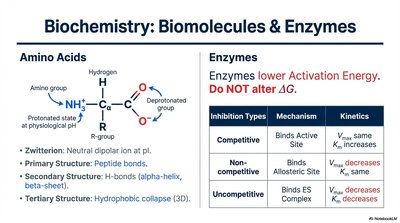
Amino Acids: Building blocks of proteins, each with a central carbon (alpha carbon), amino group, carboxyl group, and unique R-group.
Zwitterion: Amino acids exist as neutral dipolar ions at their isoelectric point (pI).
Protein Structure:
Primary: Sequence of amino acids linked by peptide bonds.
Secondary: Hydrogen bonding forms alpha-helices and beta-sheets.
Tertiary: Three-dimensional folding driven by hydrophobic collapse.
Enzymes: Biological catalysts that lower activation energy but do not alter the free energy change () of reactions.
Enzyme Inhibition:
Type
Mechanism
Kinetics
Competitive
Binds active site
same, increases
Non-competitive
Binds allosteric site
decreases, same
Uncompetitive
Binds ES complex
decreases, decreases
Metabolism: The Energy Pathways
Glycolysis, Citric Acid Cycle, and Electron Transport Chain
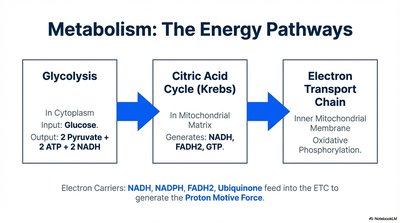
Cellular metabolism involves a series of interconnected pathways that convert glucose into usable energy. These include glycolysis, the citric acid cycle (Krebs), and the electron transport chain.
Glycolysis: Occurs in the cytoplasm; converts glucose to 2 pyruvate, producing 2 ATP and 2 NADH.
Citric Acid Cycle: Takes place in the mitochondrial matrix; generates NADH, FADH2, and GTP from pyruvate.
Electron Transport Chain: Located in the inner mitochondrial membrane; uses electron carriers (NADH, NADPH, FADH2, ubiquinone) to drive oxidative phosphorylation and generate the proton motive force.
Biology: Central Dogma & Genetics
DNA, RNA, and Protein Synthesis
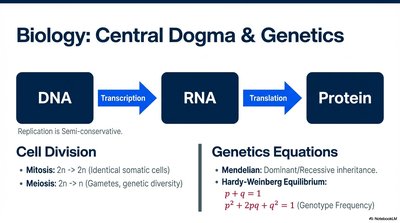
The central dogma of molecular biology describes the flow of genetic information from DNA to RNA to protein. This process is fundamental to understanding gene expression and inheritance.
Replication: DNA is copied in a semi-conservative manner.
Transcription: DNA is transcribed into RNA.
Translation: RNA is translated into protein.
Cell Division
Mitosis: Produces identical somatic cells (2n → 2n).
Meiosis: Generates gametes with genetic diversity (2n → n).
Genetics Equations
Mendelian Inheritance: Dominant/recessive traits.
Hardy-Weinberg Equilibrium: ; (genotype frequency).
Chemistry Foundations
Atomic Structure & Periodic Trends
Chemistry underpins biochemistry by explaining atomic structure, periodic properties, and chemical reactions.
Atomic Structure:
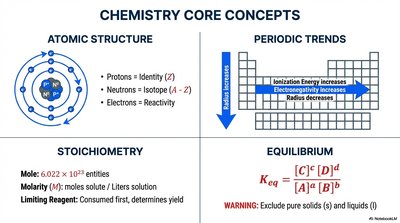
Protons determine identity ().
Neutrons determine isotope ().
Electrons determine reactivity.
Periodic Trends:
Ionization energy and electronegativity increase across a period.
Atomic radius decreases across a period.
Stoichiometry & Equilibrium
Mole: entities.
Molarity (M): Moles solute per liter solution.
Limiting Reagent: Consumed first, determines yield.
Equilibrium Constant: (exclude pure solids and liquids).
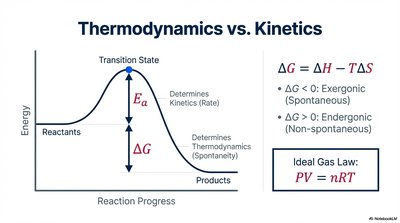
Thermodynamics vs. Kinetics
Thermodynamics determines whether a reaction is spontaneous, while kinetics determines the rate.
Free Energy Change:
: Exergonic (spontaneous)
: Endergonic (non-spontaneous)
Activation Energy (): Determines reaction rate.
Ideal Gas Law:
Organic Chemistry Foundations
Functional Groups
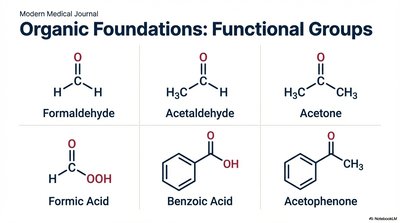
Organic chemistry is essential for understanding biomolecules. Functional groups define the chemical properties and reactivity of organic compounds.
Common Functional Groups:
Formaldehyde
Acetaldehyde
Acetone
Formic Acid
Benzoic Acid
Acetophenone
Spectroscopy
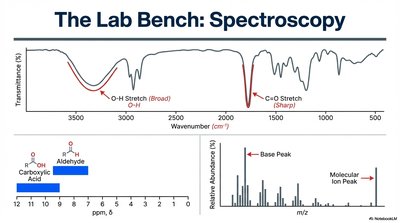
Spectroscopy is used to identify functional groups and molecular structure in organic compounds.
IR Spectroscopy: O-H stretch (broad), C=O stretch (sharp).
NMR: Chemical shifts for carboxylic acids and aldehydes.
Mass Spectrometry: Base peak and molecular ion peak.
MCAT Foundational Concepts Overview
Bio/Biochem Foundations
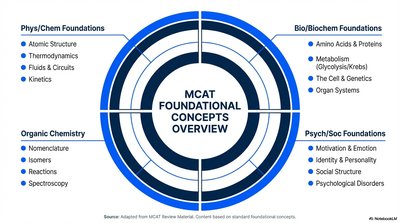
The MCAT covers foundational biochemistry concepts, including amino acids, proteins, metabolism, cell structure, and organ systems. These topics are directly relevant to college biochemistry courses.
Amino Acids & Proteins
Metabolism (Glycolysis/Krebs)
The Cell & Genetics
Organ Systems
Additional Relevant Topics
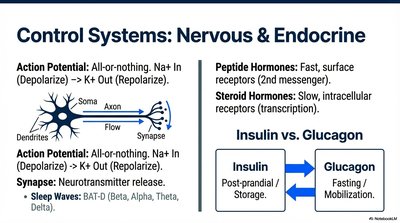
Control Systems: Nervous & Endocrine
Understanding the biochemical basis of nervous and endocrine systems is important for signal transduction and metabolic regulation.
Action Potential: All-or-nothing, Na+ influx (depolarization), K+ efflux (repolarization).
Synapse: Neurotransmitter release.
Hormones:
Peptide: Fast, surface receptors.
Steroid: Slow, intracellular receptors.
Insulin vs. Glucagon: Insulin promotes storage; glucagon mobilizes energy during fasting.
Organ Systems: Heart & Oxygen
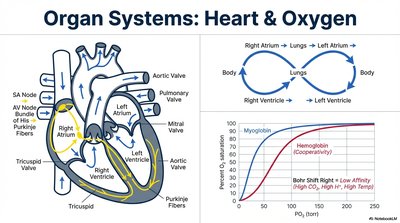
Biochemistry is integral to understanding oxygen transport and cardiovascular physiology.
Heart Anatomy: Chambers, valves, conduction system.
Oxygen Transport:
Hemoglobin: Cooperative binding.
Myoglobin: High affinity for O2.
Bohr Effect: Low pH, high CO2 decreases O2 affinity.
Summary Table: Biochemistry-Related MCAT Topics
Topic | Key Concepts |
|---|---|
Amino Acids & Proteins | Structure, function, peptide bonds, folding |
Enzymes | Catalysis, inhibition, activation energy |
Metabolism | Glycolysis, citric acid cycle, electron transport |
Genetics | Central dogma, cell division, inheritance |
Cell Structure | Membranes, organelles, transport |
Organ Systems | Heart, oxygen transport, hormonal regulation |
Additional info:
Some topics (e.g., physics, psychology, sociology) are included for MCAT completeness but are not directly relevant to biochemistry college courses.
All included images are directly relevant to the biochemistry topics discussed.
