

Pearson+ LogoPearson+ Logo
Ch. 20 Unifying Concepts of Animal Structure and Function
Taylor - Campbell Biology: Concepts & Connections 10th Edition
Taylor, Simon, Dickey, Hogan10th EditionCampbell Biology: Concepts & ConnectionsISBN: 9780136538783Not the one you use?Change textbook
Chapter 20, Problem 11

After a long, hot run together, your friend tells you that you should dunk your head into a cooler of water to lower your body temperature more rapidly, rather than sitting and waiting to cool down. What do you think? Form a hypothesis about how the ice-cold water might affect the rate at which your body temperature returns to normal. How could you test your hypothesis?

Verified step by step guidance
1
Formulate a hypothesis: Hypothesize that immersing your head in ice-cold water will lower your body temperature more rapidly than sitting and waiting to cool down. For example, 'If a person immerses their head in ice-cold water after exercise, then their body temperature will decrease faster compared to sitting and waiting to cool down.'
Identify the variables: The independent variable is the cooling method (immersing head in ice-cold water vs. sitting and waiting). The dependent variable is the rate of body temperature decrease. Control variables could include the duration of exercise, environmental temperature, and hydration levels.
Design an experiment: Divide participants into two groups. Group 1 immerses their head in ice-cold water immediately after exercise, while Group 2 sits and waits to cool down naturally. Measure body temperature at regular intervals (e.g., every 2 minutes) for a set period (e.g., 20 minutes).
Collect and analyze data: Use a thermometer to record body temperature for each participant at each time interval. Plot the data on a graph to compare the rate of temperature decrease between the two groups.
Draw conclusions: Based on the data, determine whether immersing the head in ice-cold water significantly accelerates the rate of body temperature decrease compared to sitting and waiting. Ensure the results are statistically analyzed to confirm the validity of the hypothesis.

Verified video answer for a similar problem:

This video solution was recommended by our tutors as helpful for the problem above.
Video duration:
2m
Was this helpful?

Key Concepts

Here are the essential concepts you must grasp in order to answer the question correctly.

Thermoregulation

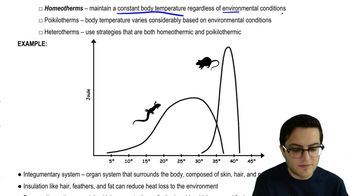
Thermoregulation is the process by which the body maintains its core internal temperature within a narrow range, despite external temperature fluctuations. This involves physiological mechanisms such as sweating, shivering, and altering blood flow to the skin. Understanding thermoregulation is crucial for evaluating how external factors, like immersion in cold water, can influence body temperature recovery after exercise.
Recommended video:
Guided course
09:51
Thermoregulation

Heat Transfer Mechanisms

Heat transfer mechanisms include conduction, convection, and evaporation, which describe how heat moves from one object to another. When you immerse your head in cold water, conduction occurs as heat is transferred from your body to the cooler water. Recognizing these mechanisms helps in hypothesizing how quickly and effectively the body can cool down in response to external cooling methods.
Recommended video:
Guided course
04:42
Horizontal Gene Transfer

Hypothesis Testing

Hypothesis testing is a scientific method used to determine the validity of a proposed explanation for a phenomenon. In this context, you could formulate a hypothesis about the effect of cold water immersion on body temperature recovery and design an experiment to measure temperature changes over time. This process involves collecting data, analyzing results, and drawing conclusions to support or refute the hypothesis.
Recommended video: