

Pearson+ LogoPearson+ Logo
Ch. 20 Unifying Concepts of Animal Structure and Function
Taylor - Campbell Biology: Concepts & Connections 10th Edition
Taylor, Simon, Dickey, Hogan10th EditionCampbell Biology: Concepts & ConnectionsISBN: 9780136538783Not the one you use?Change textbook
Chapter 20, Problem 10

In a study to examine the effectiveness of a new acne cream, participants were assigned to one of two groups: those who would be asked to use the cream for three months and those who would not use any treatment. Participants would be asked to keep a journal rating how bad they think their acne is on a scale of 1–10 each week. What are the well-designed aspects of this study? What are the limitations? How would you improve the design of this study to address these limitations?

Verified step by step guidance
1
Identify the well-designed aspects of the study: The study includes a control group (those who do not use any treatment), which allows for comparison between treated and untreated participants. Additionally, the study spans a reasonable time frame (three months) to observe potential changes in acne severity.
Recognize the limitations of the study: The study relies on self-reported data (participants rating their acne severity on a scale of 1–10), which can introduce subjective bias. There is no mention of randomization in assigning participants to groups, which could lead to selection bias. Furthermore, the study does not account for other factors that might influence acne, such as diet, stress, or hormonal changes.
Propose improvements to address subjective bias: Incorporate objective measures of acne severity, such as photographs evaluated by dermatologists using a standardized acne grading scale, in addition to self-reported data.
Address the potential for selection bias: Ensure participants are randomly assigned to the treatment and control groups to minimize differences between the groups that could affect the results.
Control for confounding variables: Collect data on factors such as diet, stress levels, and hormonal changes, and ensure these variables are accounted for in the analysis to isolate the effect of the acne cream more effectively.

Verified video answer for a similar problem:

This video solution was recommended by our tutors as helpful for the problem above.
Video duration:
1m
Was this helpful?

Key Concepts

Here are the essential concepts you must grasp in order to answer the question correctly.

Experimental Design

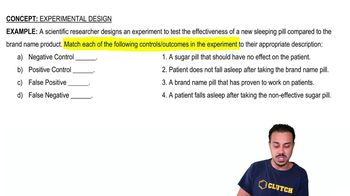
Experimental design refers to the structured approach used to conduct research, ensuring that the study can effectively test a hypothesis. In this case, the study employs a control group (no treatment) and an experimental group (acne cream), which is essential for comparing outcomes. A well-designed experiment minimizes bias and confounding variables, allowing for clearer conclusions about the treatment's effectiveness.
Recommended video:
Guided course
02:50
Experimental Design Example 1

Subjective Measurement

Subjective measurement involves collecting data based on personal opinions or perceptions, which can introduce variability and bias. In this study, participants rate their acne severity on a scale of 1–10, which may not accurately reflect actual changes in their condition. This reliance on self-reported data can lead to inconsistencies, making it crucial to consider more objective measures, such as dermatologist assessments.
Recommended video:
Guided course
06:29
Scientific Method

Longitudinal Study

A longitudinal study observes subjects over a period of time to detect changes and developments. This study spans three months, allowing researchers to track the effects of the acne cream over time. However, the duration may not be sufficient to capture long-term effects or side effects, suggesting that extending the study period or including follow-up assessments could enhance the reliability of the findings.
Recommended video:
Guided course
05:01
Levels of Ecological Study
Related Practice
Textbook Question

Which of the following best illustrates homeostasis? (Explain your answer.)

a. Most adult humans are between 5 and 6 feet tall.

b. All the cells of the body are about the same size.

c. When the salt concentration of the blood goes up, the kidneys expel more salt.

d. When oxygen in the blood decreases, you feel dizzy.

1095
views
Textbook Question

The diaphragm is a large sheet of muscle that helps move air in and out of your lungs. Breathing is automatically controlled by the brain, but you can choose to hold your breath or breathe deeper. What kind of muscle do you suppose makes up the diaphragm? (Explain your answer.)

2401
views
Textbook Question

You read a blog that states, 'A squid's eye has been perfectly designed to see in the dark depths of the ocean.' Draft a paragraph that responds to the blog's use of the phrase 'perfect design' by citing an example discussed in this chapter.

735
views
Textbook Question

After a long, hot run together, your friend tells you that you should dunk your head into a cooler of water to lower your body temperature more rapidly, rather than sitting and waiting to cool down. What do you think? Form a hypothesis about how the ice-cold water might affect the rate at which your body temperature returns to normal. How could you test your hypothesis?

830
views
Textbook Question
While driving your car over hilly terrain, you maintain a constant speed of 55 miles per hour. Write a short paragraph describing how this illustrates the concept of homeostasis.
829
views