
Pearson+ LogoPearson+ Logo
Ch. 20 Unifying Concepts of Animal Structure and Function
Taylor - Campbell Biology: Concepts & Connections 10th Edition
Taylor, Simon, Dickey, Hogan10th EditionCampbell Biology: Concepts & ConnectionsISBN: 9780136538783Not the one you use?Change textbook
Chapter 20, Problem 12

While driving your car over hilly terrain, you maintain a constant speed of 55 miles per hour. Write a short paragraph describing how this illustrates the concept of homeostasis.

Verified step by step guidance
1
Understand the concept of homeostasis: Homeostasis refers to the ability of a system or living organism to regulate its internal environment to maintain a stable, constant condition in response to changes in the external environment.
Identify the system in question: In this scenario, the system is the car, and the external environment is the hilly terrain.
Recognize the challenge to homeostasis: The varying inclines and declines of the hills could naturally cause the speed of the car to fluctuate.
Analyze the response mechanism: Maintaining a constant speed of 55 miles per hour despite the changing terrain illustrates the car's response mechanism. This is akin to biological systems where various mechanisms are employed to maintain homeostasis.
Draw parallels to biological processes: Just as the car uses adjustments in power and possibly gear changes to maintain speed, biological organisms adjust their physiological processes, such as hormone levels, temperature, and metabolism, to maintain homeostasis.

Verified video answer for a similar problem:

This video solution was recommended by our tutors as helpful for the problem above.
Video duration:
2m
Was this helpful?

Key Concepts

Here are the essential concepts you must grasp in order to answer the question correctly.

Homeostasis

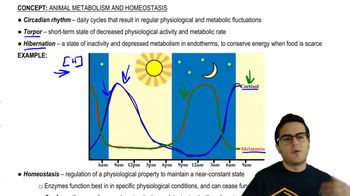
Homeostasis refers to the process by which living organisms regulate their internal environment to maintain stable, constant conditions despite external changes. This concept is crucial for survival, as it allows organisms to function optimally in varying conditions. In the context of driving, maintaining a constant speed despite hilly terrain exemplifies how systems strive to achieve equilibrium.
Recommended video:

Feedback Mechanisms

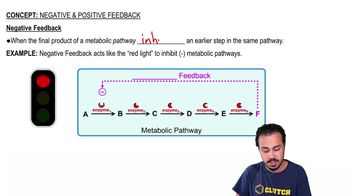
Feedback mechanisms are processes that help maintain homeostasis by responding to changes in the environment. They can be negative, where a change triggers a response that counteracts the initial change, or positive, where a change enhances the initial stimulus. In driving, adjusting the throttle or brakes in response to the incline or decline of hills serves as a feedback mechanism to maintain a steady speed.
Recommended video:
Guided course
02:41
Negative Feedback

Dynamic Equilibrium

Dynamic equilibrium is a state of balance achieved when opposing processes occur at equal rates, allowing for stability in a system. In biological systems, this means that while conditions may fluctuate, the overall state remains stable. When driving over hills, the constant speed represents a dynamic equilibrium where the driver continuously adjusts to maintain that speed, reflecting the balance between acceleration and deceleration.
Recommended video:
Guided course
03:37
Disturbances Make Communities Dynamic