Pearson+ LogoPearson+ Logo
Ch. 20 Unifying Concepts of Animal Structure and Function
Taylor - Campbell Biology: Concepts & Connections 10th Edition
Taylor, Simon, Dickey, Hogan10th EditionCampbell Biology: Concepts & ConnectionsISBN: 9780136538783Not the one you use?Change textbook
Chapter 20, Problem 9

You read a blog that states, 'A squid's eye has been perfectly designed to see in the dark depths of the ocean.' Draft a paragraph that responds to the blog's use of the phrase 'perfect design' by citing an example discussed in this chapter.

Verified step by step guidance
1
Identify the concept of 'perfect design' in biological terms, which often refers to the idea that certain features of organisms are ideally suited for their functions.
Explain the concept of natural selection and how it plays a role in the development of traits such as the squid's eye, emphasizing that these traits are not 'designed' but rather evolved through environmental pressures and survival advantages.
Discuss the specific adaptations of the squid's eye, such as its large size and the structure of its photoreceptors, which allow it to capture more light in the dark ocean depths.
Highlight the evolutionary trade-offs that might come with such adaptations, for example, how the large size of the eye might make it more susceptible to injury.
Conclude by suggesting that while the squid's eye is highly adapted to its environment, referring to it as 'perfectly designed' is a misconception, as it implies intentional design rather than the result of natural evolutionary processes.

Verified video answer for a similar problem:

This video solution was recommended by our tutors as helpful for the problem above.
Video duration:
2m
Was this helpful?

Key Concepts

Here are the essential concepts you must grasp in order to answer the question correctly.

Adaptation

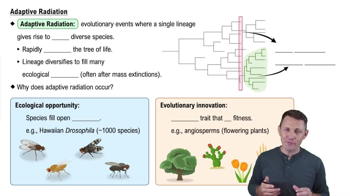
Adaptation refers to the evolutionary process through which organisms develop traits that enhance their survival and reproduction in specific environments. In the context of squids, their eyes have adapted to function effectively in low-light conditions, allowing them to detect prey and predators in the dark depths of the ocean. This concept highlights how features can evolve over time to meet the demands of an organism's habitat.
Recommended video:
05:24
Adaptive Radiation

Natural Selection

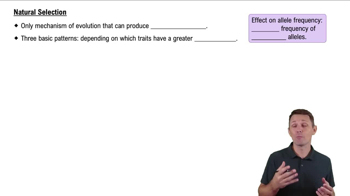
Natural selection is a mechanism of evolution where individuals with advantageous traits are more likely to survive and reproduce. This process leads to the gradual accumulation of beneficial adaptations in a population. The squid's eye, which is well-suited for dark environments, exemplifies how natural selection can shape anatomical features to improve an organism's fitness in its ecological niche.
Recommended video:
04:43
Natural Selection

Convergent Evolution

Convergent evolution occurs when unrelated species develop similar traits or adaptations in response to comparable environmental challenges. The squid's eye is often compared to the vertebrate eye, as both have evolved to optimize vision in low-light conditions despite their different evolutionary backgrounds. This concept illustrates that 'perfect design' can arise independently in different lineages facing similar ecological pressures.
Recommended video:
Guided course
05:22
Convergent and Divergent Evolution
Related Practice
Textbook Question
Describe ways in which the bodies of complex animals are structured for exchanging materials with the environment. Do all animals share such features?
799
views
Textbook Question

Which of the following best illustrates homeostasis? (Explain your answer.)

a. Most adult humans are between 5 and 6 feet tall.

b. All the cells of the body are about the same size.

c. When the salt concentration of the blood goes up, the kidneys expel more salt.

d. When oxygen in the blood decreases, you feel dizzy.

1095
views
Textbook Question

The diaphragm is a large sheet of muscle that helps move air in and out of your lungs. Breathing is automatically controlled by the brain, but you can choose to hold your breath or breathe deeper. What kind of muscle do you suppose makes up the diaphragm? (Explain your answer.)

2401
views
Textbook Question

In a study to examine the effectiveness of a new acne cream, participants were assigned to one of two groups: those who would be asked to use the cream for three months and those who would not use any treatment. Participants would be asked to keep a journal rating how bad they think their acne is on a scale of 1–10 each week. What are the well-designed aspects of this study? What are the limitations? How would you improve the design of this study to address these limitations?

757
views
Textbook Question

After a long, hot run together, your friend tells you that you should dunk your head into a cooler of water to lower your body temperature more rapidly, rather than sitting and waiting to cool down. What do you think? Form a hypothesis about how the ice-cold water might affect the rate at which your body temperature returns to normal. How could you test your hypothesis?

830
views
Textbook Question
While driving your car over hilly terrain, you maintain a constant speed of 55 miles per hour. Write a short paragraph describing how this illustrates the concept of homeostasis.
829
views