
Pearson+ LogoPearson+ Logo
Ch. 33 Control Systems in Plants
Taylor - Campbell Biology: Concepts & Connections 10th Edition
Taylor, Simon, Dickey, Hogan10th EditionCampbell Biology: Concepts & ConnectionsISBN: 9780136538783Not the one you use?Change textbook
Chapter 33, Problem 6

Buds and sprouts often form on tree stumps. Which hormone would stimulate their formation?
a. Auxin
b. Cytokinin
c. Abscisic acid
d. Ethylene

Verified step by step guidance
1
Understand the role of plant hormones: Begin by reviewing the functions of the hormones listed in the options. Auxin is involved in cell elongation and apical dominance, cytokinin promotes cell division and shoot formation, abscisic acid is responsible for stress responses and dormancy, and ethylene regulates fruit ripening and leaf abscission.
Focus on the process of bud and sprout formation: Buds and sprouts are formed through active cell division and shoot development. Identify which hormone is primarily responsible for stimulating these processes.
Eliminate irrelevant options: Abscisic acid and ethylene are not directly involved in promoting bud and sprout formation. Abscisic acid inhibits growth, while ethylene is more associated with fruit ripening and senescence.
Compare auxin and cytokinin: While auxin plays a role in maintaining apical dominance (preventing lateral bud growth), cytokinin is known to counteract this effect and promote the growth of lateral buds and shoots.
Conclude the correct hormone: Based on the function of cytokinin in stimulating cell division and shoot formation, it is the hormone most likely responsible for the formation of buds and sprouts on tree stumps.

Verified video answer for a similar problem:

This video solution was recommended by our tutors as helpful for the problem above.
Video duration:
1m
Was this helpful?

Key Concepts

Here are the essential concepts you must grasp in order to answer the question correctly.

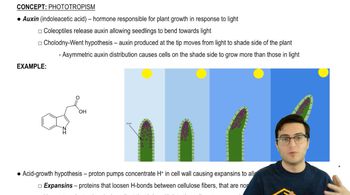
Auxin

Auxin is a plant hormone that plays a crucial role in regulating growth and development. It promotes cell elongation, root formation, and the development of buds and shoots. In the context of tree stumps, auxin is responsible for stimulating the growth of new shoots from dormant buds, making it essential for regeneration.
Recommended video:

Cytokinin

Cytokinins are a class of plant hormones that promote cell division and shoot formation. They work in conjunction with auxins to regulate growth patterns and are particularly important in the development of lateral buds. While they can stimulate bud growth, auxin is more directly responsible for the initial formation of sprouts on stumps.
Recommended video:
Guided course
05:19
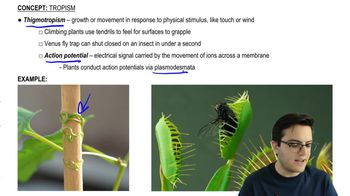
Thigmotropism and Cytokinins

Abscisic Acid

Abscisic acid (ABA) is a plant hormone primarily involved in stress responses and the regulation of seed dormancy. It generally inhibits growth and promotes the closing of stomata during drought conditions. In the context of bud formation, ABA does not stimulate growth; rather, it acts to conserve resources, making it less relevant to the question of sprout formation on tree stumps.
Recommended video:
Related Practice
Textbook Question

Auxin causes a shoot to bend toward the light by

a. Causing cells to shrink on the dark side of the shoot

b. Stimulating growth on the dark side of the shoot

c. Causing cells to shrink on the lighted side of the shoot

d. Stimulating growth on the lighted side of the shoot

1381
views
Textbook Question

In autumn, the amount of _________ increases and the amount of _________ decreases in fruits and leaf stalks, causing a plant to drop fruit and leaves.

a. Ethylene … auxin

b. Gibberellin … abscisic acid

c. Cytokinin … abscisic acid

d. Auxin … ethylene

1040
views
Textbook Question

Plant hormones act by affecting the activities of:

a. Genes

b. Membranes

c. Enzymes

d. Genes, membranes, and enzymes

1224
views
Textbook Question

Which of the following is a type of defense used by plants to deter herbivores?

a. Chemicals toxic to the herbivore

b. Chemicals that recruit other animals

c. Spines

d. a, b, and c

1186
views
Textbook Question

"Match each definition with the correct term.

Bending of a shoot toward light, Growth response to touch, Cycle with a period of about 24 hours Pigment that helps control flowering Relative lengths of night and day Growth response to gravity Folding of plant leaves at night

a. Phytochrome

b. Photoperiod

c. Sleep movement

d. Circadian rhythm

e. Thigmotropism

f. Phototropism

g. Gravitropism"

951
views
Textbook Question
A certain short-day plant flowers only when days are less than 12 hours long. Which of the following would cause it to flower?a. a 9-hour night and 15-hour day with 1 minute of darkness after 7 hoursb. an 8-hour day and 16-hour night with a flash of white light after 8 hoursc. a 13-hour night and 11-hour day with 1 minute of darkness after 6 hoursd. a 12-hour day and 12-hour night with a flash of red light after 6 hours
1306
views