Pearson+ LogoPearson+ Logo
Ch. 33 Control Systems in Plants
Taylor - Campbell Biology: Concepts & Connections 10th Edition
Taylor, Simon, Dickey, Hogan10th EditionCampbell Biology: Concepts & ConnectionsISBN: 9780136538783Not the one you use?Change textbook
Chapter 33, Problem 15

A certain short-day plant flowers only when days are less than 12 hours long. Which of the following would cause it to flower?a. a 9-hour night and 15-hour day with 1 minute of darkness after 7 hoursb. an 8-hour day and 16-hour night with a flash of white light after 8 hoursc. a 13-hour night and 11-hour day with 1 minute of darkness after 6 hoursd. a 12-hour day and 12-hour night with a flash of red light after 6 hours

Verified step by step guidance
1
Identify the critical day length for the plant to flower, which is less than 12 hours of daylight.
Review each option to determine the total amount of daylight the plant receives.
Consider the effect of any interruptions in the light or dark period, such as flashes of light or periods of darkness, on the plant's perception of day length.
Evaluate how these interruptions might reset the plant's internal clock, particularly focusing on whether they make the plant 'think' the day is shorter or longer.
Select the option where the total daylight does not exceed 12 hours and interruptions support the perception of a shorter day.

Verified video answer for a similar problem:

This video solution was recommended by our tutors as helpful for the problem above.
Video duration:
1m
Was this helpful?

Key Concepts

Here are the essential concepts you must grasp in order to answer the question correctly.

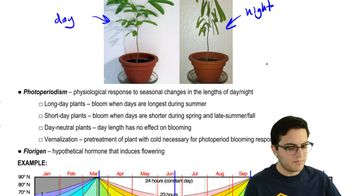
Photoperiodism

Photoperiodism is the physiological reaction of organisms to the length of day or night. In plants, it determines flowering and other developmental processes based on the duration of light exposure. Short-day plants, like the one in the question, require longer nights to trigger flowering, typically needing nights longer than a specific threshold, such as 12 hours.
Recommended video:
Guided course
04:34
Photoderiodism

Critical Night Length

Critical night length is the minimum duration of darkness required for a plant to initiate flowering. For short-day plants, this length must exceed a certain number of hours, which signals the plant to begin the flowering process. If the night is shorter than this critical length, the plant will not flower, regardless of the day length.
Recommended video:
03:54
Interpreting Branch Length

Light Interruption

Light interruption refers to the exposure of plants to light during their dark period, which can disrupt the flowering process. A brief flash of light during the night can reset the plant's perception of night length, potentially preventing flowering in short-day plants. The type of light (e.g., red or white) and its timing are crucial in determining the plant's response.
Recommended video:
Guided course
15:15
Steps of the Light Reactions