Pearson+ LogoPearson+ Logo
Ch. 33 Control Systems in Plants
Taylor - Campbell Biology: Concepts & Connections 10th Edition
Taylor, Simon, Dickey, Hogan10th EditionCampbell Biology: Concepts & ConnectionsISBN: 9780136538783Not the one you use?Change textbook
Chapter 33, Problem 8

"Match each definition with the correct term.
Bending of a shoot toward light, Growth response to touch, Cycle with a period of about 24 hours Pigment that helps control flowering Relative lengths of night and day Growth response to gravity Folding of plant leaves at night
a. Phytochrome
b. Photoperiod
c. Sleep movement
d. Circadian rhythm
e. Thigmotropism
f. Phototropism
g. Gravitropism"
Diagram illustrating plant tropisms and their definitions for biology course.

Verified step by step guidance
1
Identify the definition 'Bending of a shoot toward light' and match it with the term 'phototropism', which refers to the growth of plant shoots toward a light source.
Match the definition 'Growth response to touch' with the term 'thigmotropism', which describes how plants respond to physical contact, such as vines wrapping around a support.
Associate the definition 'Cycle with a period of about 24 hours' with the term 'circadian rhythm', which refers to biological processes that follow a roughly 24-hour cycle.
Link the definition 'Pigment that helps control flowering' with the term 'phytochrome', a light-sensitive pigment involved in regulating plant responses to light, including flowering.
Match the definition 'Relative lengths of night and day' with the term 'photoperiod', which is the environmental cue that influences processes like flowering based on the duration of light and darkness.

Verified video answer for a similar problem:

This video solution was recommended by our tutors as helpful for the problem above.
Video duration:
2m
Was this helpful?

Key Concepts

Here are the essential concepts you must grasp in order to answer the question correctly.

Phototropism

Phototropism is the growth response of a plant toward light. This phenomenon occurs due to the unequal distribution of auxins, plant hormones that promote cell elongation. When light shines on one side of a plant, auxins accumulate on the shaded side, causing that side to grow faster and resulting in the bending of the plant toward the light source.
Recommended video:
Guided course
02:00
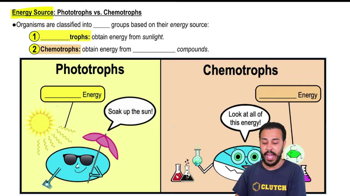
Energy Source: Phototrophs vs. Chemotrophs

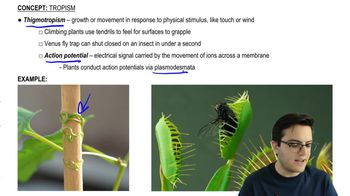
Thigmotropism

Thigmotropism refers to the directional growth of a plant in response to touch or physical contact. This response is particularly evident in climbing plants, which wrap around supports as they grow. The mechanism involves the perception of touch, leading to localized growth changes that allow the plant to adapt and secure itself to its environment.
Recommended video:
Guided course
05:19
Thigmotropism and Cytokinins

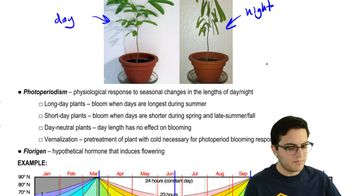
Circadian Rhythm

Circadian rhythm is a biological process that displays an endogenous, entrainable oscillation of about 24 hours. In plants, this rhythm regulates various physiological processes, including flowering and leaf movements, in response to the light-dark cycle. It is crucial for optimizing growth and development by aligning biological functions with environmental changes.
Recommended video:
Guided course
04:34
Photoderiodism