Pearson+ LogoPearson+ Logo
Ch. 12 DNA Technology and Genomics
Taylor - Campbell Biology: Concepts & Connections 10th Edition
Taylor, Simon, Dickey, Hogan10th EditionCampbell Biology: Concepts & ConnectionsISBN: 9780136538783Not the one you use?Change textbook
Chapter 12, Problem 6

When a typical restriction enzyme cuts a DNA molecule, the cuts are uneven, giving the DNA fragments single-stranded ends. These ends are useful in recombinant DNA work because
a. They enable a cell to recognize fragments produced by the enzyme.
b. They serve as starting points for DNA replication.
c. The fragments will bond to other fragments with complementary ends.
d. They enable researchers to use the fragments as molecular probes.

Verified step by step guidance
1
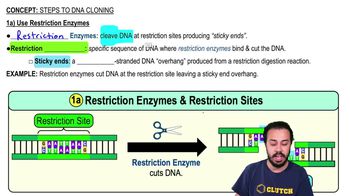
Understand the role of restriction enzymes: Restriction enzymes are proteins that cut DNA at specific sequences, often creating 'sticky ends' or single-stranded overhangs. These sticky ends are important in molecular biology because they can pair with complementary sequences.
Analyze the options provided: Each option describes a potential function of the single-stranded ends created by restriction enzymes. Evaluate each option based on biological principles.
Option a: 'They enable a cell to recognize fragments produced by the enzyme.' This is incorrect because cells do not inherently recognize DNA fragments based on restriction enzyme cuts.
Option b: 'They serve as starting points for DNA replication.' This is incorrect because single-stranded ends are not typically used as replication starting points; replication requires specific sequences like origins of replication.
Option c: 'The fragments will bond to other fragments with complementary ends.' This is correct because the single-stranded ends created by restriction enzymes can form hydrogen bonds with complementary sequences, facilitating the joining of DNA fragments in recombinant DNA techniques.

Verified video answer for a similar problem:

This video solution was recommended by our tutors as helpful for the problem above.
Video duration:
1m
Was this helpful?

Key Concepts

Here are the essential concepts you must grasp in order to answer the question correctly.

Restriction Enzymes

Restriction enzymes are proteins that cut DNA at specific sequences, creating fragments with either blunt or sticky ends. The uneven cuts result in single-stranded overhangs, known as sticky ends, which are crucial for various molecular biology techniques, including cloning and recombinant DNA technology.
Recommended video:
Guided course
03:27
1a) Use Restriction Enzymes

Recombinant DNA Technology

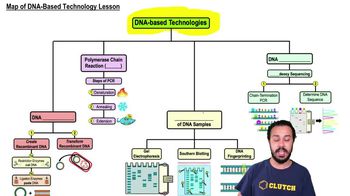
Recombinant DNA technology involves combining DNA from different sources to create new genetic combinations. The sticky ends produced by restriction enzymes facilitate the joining of DNA fragments from different organisms, allowing for the insertion of genes into plasmids or other vectors for cloning or expression in host cells.
Recommended video:
Guided course
03:12
Map of DNA-Based Technology Lesson

Complementary Base Pairing

Complementary base pairing refers to the specific hydrogen bonding between nucleotide bases in DNA, where adenine pairs with thymine and cytosine pairs with guanine. This property is essential for the annealing of DNA fragments with sticky ends, as the complementary sequences allow the fragments to bond together, forming stable recombinant molecules.
Recommended video:
Related Practice
Textbook Question

The DNA profiles used as evidence in a murder trial look something like supermarket bar codes. The pattern of bars in a DNA profile shows

a. The order of bases in a particular gene.

b. The presence of various-sized fragments of DNA.

c. The presence of dominant or recessive alleles for particular traits.

d. The order of genes along particular chromosomes.

1157
views
Textbook Question

A paleontologist has recovered a tiny bit of organic material from the 400-year-old preserved skin of an extinct dodo. She would like to compare DNA from the sample with DNA from living birds. Which of the following would be most useful for increasing the amount of DNA available for testing?

a. Restriction fragment analysis

b. Polymerase chain reaction

c. Molecular probe analysis

d. Electrophoresis

798
views
Textbook Question

How many genes are there in a human sperm cell?

a. 23

b. 46

c. About 21,000

d. about 3 billion

1793
views
Textbook Question
Why does DNA profiling rely on comparing specific genetic markers rather than the entire genome?
1205
views
Textbook Question
Recombinant DNA techniques are used to custom-build bacteria for two main purposes: to obtain multiple copies of certain genes and to obtain useful proteins produced by certain genes. Give an example of each of these applications in medicine and agriculture.
1301
views
Textbook Question
A biochemist hopes to find a gene in human cells that codes for an important blood-clotting protein. She knows that the nucleotide sequence of a small part of the blood-clotting gene is CTGGACTGACA. Briefly outline a possible method she might use to isolate the desired gene.
785
views