
Pearson+ LogoPearson+ Logo
Ch. 12 DNA Technology and Genomics
Taylor - Campbell Biology: Concepts & Connections 10th Edition
Taylor, Simon, Dickey, Hogan10th EditionCampbell Biology: Concepts & ConnectionsISBN: 9780136538783Not the one you use?Change textbook
Chapter 12, Problem 5

How many genes are there in a human sperm cell?
a. 23
b. 46
c. About 21,000
d. about 3 billion

Verified step by step guidance
1
Understand that a human sperm cell is a haploid cell, meaning it contains half the number of chromosomes found in a diploid (somatic) cell.
Recall that humans have 46 chromosomes in their diploid cells, which means a sperm cell contains 23 chromosomes.
Each chromosome contains many genes. In humans, the total number of genes across all chromosomes is approximately 21,000.
Since a sperm cell contains one copy of each chromosome (23 chromosomes), it also contains approximately 21,000 genes, as the number of genes does not change between haploid and diploid cells.
Note that the number of base pairs in the human genome is about 3 billion, but this refers to the total DNA sequence, not the number of genes.

Verified video answer for a similar problem:

This video solution was recommended by our tutors as helpful for the problem above.
Video duration:
58s
Was this helpful?

Key Concepts

Here are the essential concepts you must grasp in order to answer the question correctly.

Human Genome

The human genome consists of approximately 3 billion base pairs of DNA, which encode the genetic information necessary for the development and functioning of a human being. It is organized into 23 pairs of chromosomes, with one set inherited from each parent. Each chromosome contains numerous genes, which are segments of DNA that code for proteins.
Recommended video:
Guided course
05:30
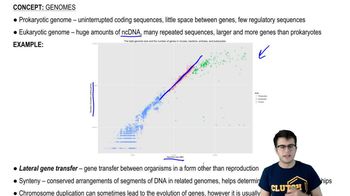
Genomes and Genome Evolution

Gametes and Chromosome Number

Human sperm cells are gametes, which are reproductive cells that contain half the number of chromosomes found in somatic (body) cells. In humans, somatic cells have 46 chromosomes (23 pairs), while gametes, including sperm, have only 23 individual chromosomes. This reduction is crucial for sexual reproduction, ensuring that when sperm and egg unite, the resulting zygote has the correct diploid number.
Recommended video:
Guided course
08:09
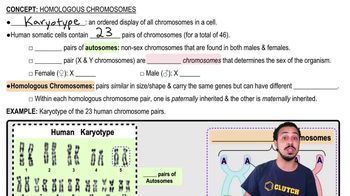
Homologous Chromosomes

Gene Count in Sperm Cells

While the total number of genes in the human genome is estimated to be around 21,000, each sperm cell carries only one copy of each gene, corresponding to the 23 chromosomes it contains. Therefore, the number of distinct genes present in a human sperm cell is not 46 or 3 billion, but rather the number of genes represented in the 23 chromosomes, which is approximately 21,000.
Recommended video:
Guided course
05:02
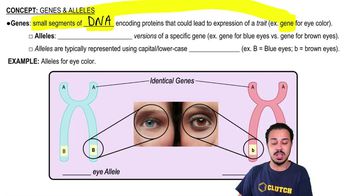
Genes & Alleles
Related Practice
Textbook Question

Which of the following would be considered a transgenic organism?

a. A bacterium that has received genes via conjugation

b. A human given a corrected human blood-clotting gene

c. A fern grown in cell culture from a single fern root cell

d. A rat with rabbit hemoglobin genes

1452
views
Textbook Question

The DNA profiles used as evidence in a murder trial look something like supermarket bar codes. The pattern of bars in a DNA profile shows

a. The order of bases in a particular gene.

b. The presence of various-sized fragments of DNA.

c. The presence of dominant or recessive alleles for particular traits.

d. The order of genes along particular chromosomes.

1157
views
Textbook Question

A paleontologist has recovered a tiny bit of organic material from the 400-year-old preserved skin of an extinct dodo. She would like to compare DNA from the sample with DNA from living birds. Which of the following would be most useful for increasing the amount of DNA available for testing?

a. Restriction fragment analysis

b. Polymerase chain reaction

c. Molecular probe analysis

d. Electrophoresis

798
views
Textbook Question

When a typical restriction enzyme cuts a DNA molecule, the cuts are uneven, giving the DNA fragments single-stranded ends. These ends are useful in recombinant DNA work because

a. They enable a cell to recognize fragments produced by the enzyme.

b. They serve as starting points for DNA replication.

c. The fragments will bond to other fragments with complementary ends.

d. They enable researchers to use the fragments as molecular probes.

1563
views
Textbook Question
Why does DNA profiling rely on comparing specific genetic markers rather than the entire genome?
1205
views
Textbook Question
Recombinant DNA techniques are used to custom-build bacteria for two main purposes: to obtain multiple copies of certain genes and to obtain useful proteins produced by certain genes. Give an example of each of these applications in medicine and agriculture.
1301
views