Pearson+ LogoPearson+ Logo
Ch. 19 The Evolution of Vertebrate Diversity
Taylor - Campbell Biology: Concepts & Connections 10th Edition
Taylor, Simon, Dickey, Hogan10th EditionCampbell Biology: Concepts & ConnectionsISBN: 9780136538783Not the one you use?Change textbook
Chapter 19, Problem 13

What adaptations inherited from our primate ancestors enable humans to make and use tools?

Verified step by step guidance
1
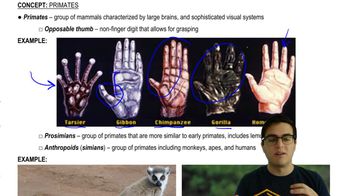
Identify the key physical adaptations: Discuss the physical traits inherited from primate ancestors that are crucial for tool making and usage. These include opposable thumbs, which allow for a precision grip, and enhanced hand-eye coordination, which is essential for manipulating objects.
Consider the cognitive adaptations: Highlight the cognitive abilities that have evolved in humans, such as advanced problem-solving skills and the capacity for complex thought. These cognitive skills are necessary for conceptualizing tools and understanding how they can be used to interact with the environment.
Examine the role of bipedalism: Explain how walking on two legs (bipedalism) has freed up the hands for other uses, such as carrying and using tools. This adaptation is significant as it allows humans to perform tasks while moving.
Discuss the importance of vision: Elaborate on how changes in the visual system, such as better depth perception and color vision, have supported tool use. These visual adaptations enable more precise handling and manipulation of tools.
Explore social learning and culture: Describe how the ability to learn from others and cultural transmission have played a role in the development and refinement of tool use. This includes the ability to observe and mimic the tool-making behaviors of others, which is a trait seen in many primates.

Verified video answer for a similar problem:

This video solution was recommended by our tutors as helpful for the problem above.
Video duration:
1m
Was this helpful?

Key Concepts

Here are the essential concepts you must grasp in order to answer the question correctly.

Opposable Thumbs

Opposable thumbs are a key adaptation inherited from primate ancestors that allow for a strong grip and precise manipulation of objects. This anatomical feature enables humans to grasp tools effectively, facilitating intricate movements necessary for tool-making and usage.
Recommended video:

Cognitive Abilities

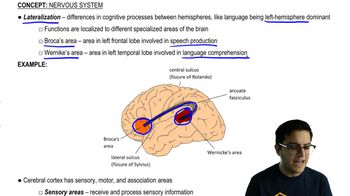
Humans possess advanced cognitive abilities, including problem-solving, planning, and abstract thinking, which are crucial for tool use. These cognitive skills allow individuals to conceptualize the function of tools, innovate new designs, and improve techniques over time, reflecting a significant evolutionary advantage.
Recommended video:
Guided course
04:07
Motor, Sensory, and Association Areas

Social Learning

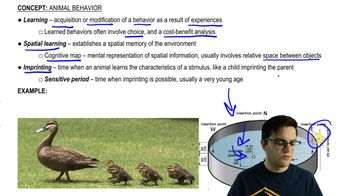
Social learning is the process through which individuals acquire skills and knowledge by observing others. This adaptation, rooted in our primate heritage, enables humans to share and transmit tool-making techniques across generations, enhancing cultural evolution and the refinement of tool use.
Recommended video:
Guided course
05:37
Learning and Communication