Pearson+ LogoPearson+ Logo
Ch. 19 The Evolution of Vertebrate Diversity
Taylor - Campbell Biology: Concepts & Connections 10th Edition
Taylor, Simon, Dickey, Hogan10th EditionCampbell Biology: Concepts & ConnectionsISBN: 9780136538783Not the one you use?Change textbook
Chapter 19, Problem 16

Explain some of the reasons why the human species has been able to expand in number and distribution to a greater extent than most other animals.

Verified step by step guidance
1
Identify the unique characteristics of humans that differentiate them from other species, such as advanced cognitive abilities, which allow for complex communication, problem-solving, and the development of cultures.
Discuss the development and use of technology by humans, which has enabled them to modify and adapt to various environments, leading to the creation of tools, clothing, and shelters that protect them from natural elements and predators.
Examine the social structure of human societies, which often involves cooperative living and social networks that provide mutual aid and protection, enhancing survival and reproductive success.
Consider the impact of agricultural developments, which began around 10,000 years ago and allowed humans to produce surplus food, leading to population growth and the establishment of permanent settlements.
Explore the role of medical advancements in increasing human lifespan and survival rates, including the development of vaccines, antibiotics, and other medical treatments that have significantly reduced mortality from diseases.

Verified video answer for a similar problem:

This video solution was recommended by our tutors as helpful for the problem above.
Video duration:
1m
Was this helpful?

Key Concepts

Here are the essential concepts you must grasp in order to answer the question correctly.

Adaptability

Humans possess a remarkable ability to adapt to diverse environments, which has allowed them to thrive in various climates and geographical locations. This adaptability is facilitated by cultural practices, technological innovations, and social structures that enable survival and resource utilization in different settings.
Recommended video:
05:24
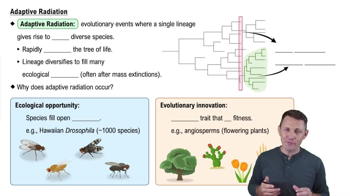
Adaptive Radiation

Social Cooperation

The capacity for social cooperation is a defining trait of humans, enabling them to work together in groups for mutual benefit. This cooperation has led to the development of complex societies, sharing of resources, and collective problem-solving, which enhances survival and promotes population growth.
Recommended video:
Guided course
07:48
Diffusion of Gases

Technological Advancement

Technological advancements have significantly contributed to human expansion by improving food production, healthcare, and living conditions. Innovations such as agriculture, medicine, and transportation have allowed humans to increase their numbers and spread across the globe, overcoming environmental challenges that limit other species.
Recommended video:
Guided course
02:30
Introduction to DNA-Based Technology