Pearson+ LogoPearson+ Logo
Ch. 19 The Evolution of Vertebrate Diversity
Taylor - Campbell Biology: Concepts & Connections 10th Edition
Taylor, Simon, Dickey, Hogan10th EditionCampbell Biology: Concepts & ConnectionsISBN: 9780136538783Not the one you use?Change textbook
Chapter 19, Problem 15

A good scientific hypothesis is based on existing evidence and leads to testable predictions. What hypothesis did the paleontologists who discovered Tiktaalik test? What evidence did they use to predict where they would find fossils of transitional forms?

Verified step by step guidance
1
Understand the concept of a scientific hypothesis: A hypothesis is a proposed explanation for a phenomenon based on existing evidence, and it must lead to testable predictions.
Recognize the context of Tiktaalik: Tiktaalik is a transitional fossil that exhibits features of both aquatic fish and terrestrial tetrapods, providing evidence for the evolutionary transition from water to land.
Identify the hypothesis tested by paleontologists: The paleontologists hypothesized that transitional forms like Tiktaalik would be found in sedimentary rocks from a specific geological time period when the transition from aquatic to terrestrial life occurred.
Examine the evidence used to predict fossil locations: Paleontologists used existing evidence from geology and evolutionary biology, such as the age of rocks (Devonian period, approximately 375 million years ago) and the environments where early tetrapods were likely to have lived (shallow water habitats).
Describe the testing process: Based on their hypothesis and evidence, paleontologists searched for fossils in sedimentary rocks of the appropriate age and type in regions that were once shallow aquatic environments, leading to the discovery of Tiktaalik.

Verified video answer for a similar problem:

This video solution was recommended by our tutors as helpful for the problem above.
Video duration:
2m
Was this helpful?

Key Concepts

Here are the essential concepts you must grasp in order to answer the question correctly.

Hypothesis Formation

A scientific hypothesis is a testable statement that predicts the relationship between variables based on existing knowledge. In the context of paleontology, hypotheses often arise from observed patterns in fossil records and evolutionary theory, guiding researchers in their search for transitional forms that illustrate evolutionary changes.
Recommended video:
Guided course
08:22
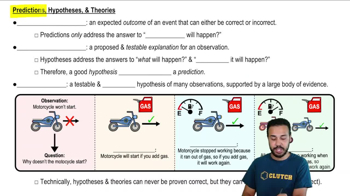
Predictions, Hypotheses, & Theories

Transitional Fossils

Transitional fossils are remains of organisms that exhibit traits common to both ancestral and derived groups, providing evidence for evolutionary change. The discovery of such fossils, like Tiktaalik, supports the theory of evolution by demonstrating the gradual transition from aquatic to terrestrial life, showcasing intermediate characteristics.
Recommended video:
03:54
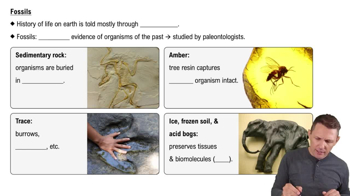
Fossils

Evidence-Based Prediction

In scientific research, predictions are made based on existing evidence, such as geological formations, previous fossil finds, and evolutionary relationships. Paleontologists use this evidence to hypothesize where transitional fossils might be located, often focusing on specific strata or regions that align with their understanding of evolutionary history.
Recommended video: