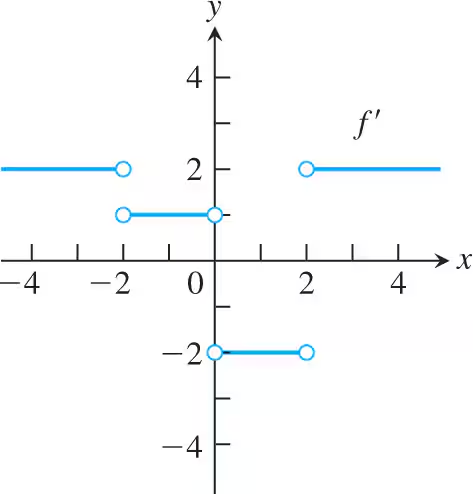
In Exercises 61 and 62, the graph of f' is given. Assume that f is continuous, and determine the x-values corresponding to local minima and local maxima.
Verified step by step guidance
1
Examine the graph of f'. The graph shows horizontal lines, indicating constant values of f' over intervals.
Identify the intervals where f' is positive, negative, or zero. Positive values of f' suggest f is increasing, negative values suggest f is decreasing, and zero values suggest potential extrema.
Look for points where f' changes sign. These points are candidates for local extrema. A change from positive to negative indicates a local maximum, while a change from negative to positive indicates a local minimum.
In the graph, f' is positive for x < 0, zero at x = 0, and negative for x > 0. This suggests a local maximum at x = 0.
Verify the continuity of f at the identified points. Since f is continuous, the behavior of f' at these points confirms the presence of local extrema.
Verified video answer for a similar problem:
This video solution was recommended by our tutors as helpful for the problem above
Video duration:
3m
Play a video:
0 Comments
Key Concepts
Here are the essential concepts you must grasp in order to answer the question correctly.
Derivative and Critical Points
The derivative of a function, denoted as f', represents the rate of change of the function f. Critical points occur where the derivative is zero or undefined, indicating potential locations for local maxima or minima. Analyzing these points is essential for identifying where the function changes from increasing to decreasing or vice versa.
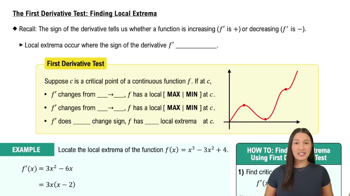
The First Derivative Test is a method used to determine the nature of critical points. If f' changes from positive to negative at a critical point, it indicates a local maximum; if it changes from negative to positive, it indicates a local minimum. This test helps in classifying the extrema based on the behavior of the derivative around the critical points.
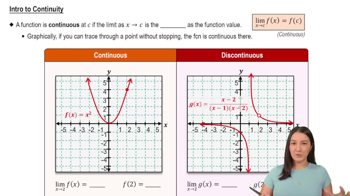
Continuity of a function f is crucial for applying the concepts of calculus effectively. A continuous function does not have breaks, jumps, or holes, ensuring that the behavior of f' accurately reflects the behavior of f. This property guarantees that local extrema identified through the derivative correspond to actual extrema in the function itself.