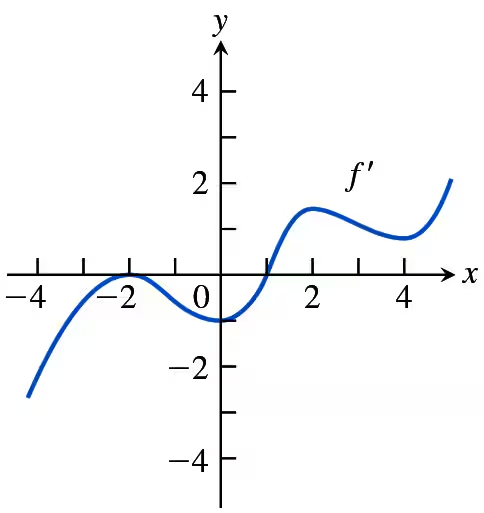
In Exercises 61 and 62, the graph of f' is given. Assume that f is continuous, and determine the x-values corresponding to local minima and local maxima.
Verified step by step guidance
1
Recall that the graph given is of the derivative \(f'(x)\) of the function \(f(x)\). To find local maxima and minima of \(f(x)\), we need to analyze the behavior of \(f'(x)\) around its zeros.
Identify the points where \(f'(x) = 0\) by locating the x-values where the graph of \(f'(x)\) crosses the x-axis. These points are candidates for local extrema of \(f(x)\).
Determine the sign change of \(f'(x)\) around each zero:
- If \(f'(x)\) changes from positive to negative at a zero, then \(f(x)\) has a local maximum there.
- If \(f'(x)\) changes from negative to positive at a zero, then \(f(x)\) has a local minimum there.
Examine the graph near each zero of \(f'(x)\) and note the sign of \(f'(x)\) just before and just after the zero to classify the extrema accordingly.
Summarize the x-values where \(f'(x)\) crosses zero and the corresponding sign changes to list the local minima and maxima of \(f(x)\).
Verified video answer for a similar problem:

This video solution was recommended by our tutors as helpful for the problem above
Video duration:
4m
Play a video:
0 Comments
Key Concepts
Here are the essential concepts you must grasp in order to answer the question correctly.
Critical Points and Extrema
Critical points occur where the derivative f' is zero or undefined. These points are candidates for local maxima, minima, or saddle points. To identify local extrema, analyze the behavior of f' around these points, as they indicate where the slope of the original function f changes.
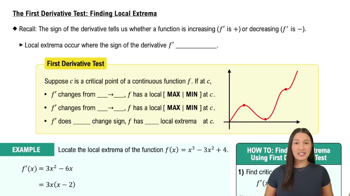
The First Derivative Test uses the sign changes of f' to determine local extrema. If f' changes from positive to negative at a critical point, f has a local maximum there. If f' changes from negative to positive, f has a local minimum. No sign change means no local extremum at that point.
The graph of f' shows the slope of f at each x-value. Points where f' crosses the x-axis (f' = 0) are critical points. By observing whether f' goes from positive to negative or vice versa at these points, one can identify local maxima and minima of f without needing the explicit form of f.