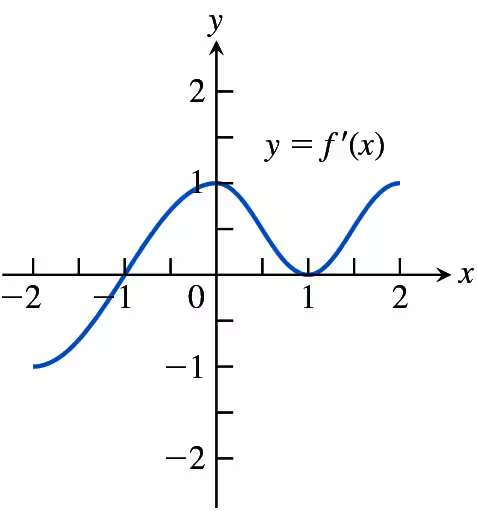
In Exercises 63 and 64, the graph of f' is given. Assume that f has domain (-2, 2).
a. Either use the graph to determine which intervals f is increasing on and which intervals f is decreasing on, or explain why this information cannot be determined from the graph.
Verified step by step guidance
1
Step 1: Recall that the graph provided represents f'(x), the derivative of f(x). The derivative indicates the slope of the tangent line to the graph of f(x). When f'(x) > 0, f(x) is increasing, and when f'(x) < 0, f(x) is decreasing.
Step 2: Analyze the graph of f'(x) to identify intervals where f'(x) is positive (above the x-axis) and intervals where f'(x) is negative (below the x-axis). These intervals correspond to where f(x) is increasing and decreasing, respectively.
Step 3: From the graph, observe that f'(x) is positive on the intervals (-2, -1) and (0, 1). This means f(x) is increasing on these intervals.
Step 4: Similarly, observe that f'(x) is negative on the intervals (-1, 0) and (1, 2). This means f(x) is decreasing on these intervals.
Step 5: Summarize the findings: f(x) is increasing on (-2, -1) and (0, 1), and f(x) is decreasing on (-1, 0) and (1, 2). This information is determined directly from the graph of f'(x).
Verified video answer for a similar problem:
This video solution was recommended by our tutors as helpful for the problem above
Video duration:
2m
Play a video:
0 Comments
Key Concepts
Here are the essential concepts you must grasp in order to answer the question correctly.
Derivative and Increasing/Decreasing Functions
The derivative of a function, f'(x), provides information about the slope of the tangent line to the graph of the function f(x). If f'(x) > 0 on an interval, f is increasing on that interval. Conversely, if f'(x) < 0, f is decreasing. This is because a positive derivative indicates a positive slope, while a negative derivative indicates a negative slope.
Determining Where a Function is Increasing & Decreasing
Critical Points and Extrema
Critical points occur where the derivative f'(x) is zero or undefined, indicating potential local maxima or minima. To identify extrema, examine the sign changes of f'(x) around these points. If f'(x) changes from positive to negative, a local maximum is present; if it changes from negative to positive, a local minimum is present. These points are crucial for understanding the behavior of f(x).
Analyzing the graph of f'(x) involves identifying intervals where the graph is above or below the x-axis. The graph above the x-axis indicates f'(x) > 0, suggesting f is increasing, while below the x-axis indicates f'(x) < 0, suggesting f is decreasing. This visual analysis helps determine the intervals of increase and decrease for the function f(x) based on its derivative.