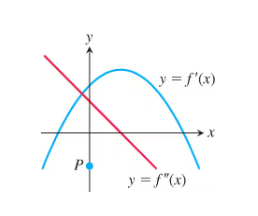
Each of Exercises 89–92 shows the graphs of the first and second derivatives of a function y=f(x). Copy the picture and add to it a sketch of the approximate graph of f, given that the graph passes through the point P.
Verified step by step guidance
1
Step 1: Analyze the given graphs. The red graph represents the first derivative y=f'(x), and the blue graph represents the second derivative y=f''(x). The point P is given as a point through which the graph of the original function y=f(x) passes.
Step 2: Understand the relationship between the derivatives and the original function. The first derivative f'(x) indicates the slope of the original function f(x), while the second derivative f''(x) indicates the concavity of f(x). Positive f''(x) means the graph of f(x) is concave up, and negative f''(x) means it is concave down.
Step 3: Observe the behavior of f'(x) (red graph). Where f'(x) is positive, the graph of f(x) is increasing. Where f'(x) is negative, the graph of f(x) is decreasing. The zero crossings of f'(x) correspond to critical points of f(x) (local maxima or minima).
Step 4: Observe the behavior of f''(x) (blue graph). Where f''(x) is positive, f(x) is concave up, and where f''(x) is negative, f(x) is concave down. The zero crossings of f''(x) correspond to inflection points of f(x).
Step 5: Sketch the graph of f(x) using the information from f'(x) and f''(x). Start at point P and use the slope information from f'(x) and the concavity information from f''(x) to approximate the shape of f(x). Ensure the graph transitions smoothly through critical points and inflection points as indicated by the derivatives.
Verified video answer for a similar problem:
This video solution was recommended by our tutors as helpful for the problem above
Video duration:
4m
Play a video:
0 Comments
Key Concepts
Here are the essential concepts you must grasp in order to answer the question correctly.
First Derivative
The first derivative of a function, denoted as f'(x), represents the rate of change of the function with respect to x. It indicates the slope of the tangent line to the graph of the function at any given point. When f'(x) is positive, the function is increasing; when it is negative, the function is decreasing. Critical points, where f'(x) equals zero, are essential for identifying local maxima and minima.
The second derivative, denoted as f''(x), measures the rate of change of the first derivative. It provides information about the concavity of the function: if f''(x) is positive, the function is concave up, indicating a local minimum; if f''(x) is negative, the function is concave down, indicating a local maximum. Points where f''(x) equals zero may indicate inflection points, where the concavity changes.
Understanding the relationship between a function and its derivatives is crucial for sketching graphs. The first derivative graph shows where the function is increasing or decreasing, while the second derivative graph indicates concavity. By analyzing these graphs together, one can infer the behavior of the original function, including its critical points, local extrema, and points of inflection, which are essential for accurately sketching the function's graph.