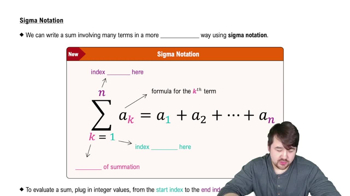
Identify the type of series given. Here, the sum is a geometric series because each term is obtained by multiplying the previous term by a constant ratio. The series is \( \sum_{k=0}^{8} 3^k \).
Recall the formula for the sum of the first \( n+1 \) terms of a geometric series: \[ S_{n} = \frac{a(r^{n+1} - 1)}{r - 1} \] where \( a \) is the first term, \( r \) is the common ratio, and \( n \) is the highest exponent index.
Identify the values for this problem: the first term \( a = 3^0 = 1 \), the common ratio \( r = 3 \), and the number of terms is \( n+1 = 9 \) since \( k \) goes from 0 to 8.
Substitute these values into the geometric sum formula: \[ S_8 = \frac{1 \times (3^{9} - 1)}{3 - 1} \]. This expression represents the sum of the series.
Simplify the denominator and prepare to evaluate the numerator (without calculating the final number), which completes the setup for finding the sum of the geometric series.
Verified video answer for a similar problem:
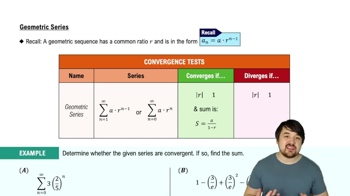
This video solution was recommended by our tutors as helpful for the problem above
Video duration:
2m
Play a video:
0 Comments
Key Concepts
Here are the essential concepts you must grasp in order to answer the question correctly.
Geometric Series
A geometric series is the sum of the terms of a geometric sequence, where each term is found by multiplying the previous term by a constant ratio. For example, in the series 3^0 + 3^1 + ... + 3^8, the common ratio is 3.
The sum of the first n+1 terms of a geometric series with initial term a and common ratio r (r ≠ 1) is given by S = a(r^(n+1) - 1) / (r - 1). This formula allows quick calculation without adding each term individually.
Exponentiation involves raising a base to a power, indicating repeated multiplication. Understanding how to interpret and manipulate expressions like 3^k is essential for evaluating terms in the geometric sum.