Find the first term a and the ratio r of each geometric series.
a. ∑ k = 0 to ∞(2/3) × (1/5)ᵏ
Verified step by step guidance
1
Identify the general form of a geometric series, which is given by the sum from k = 0 to infinity of \( a \times r^k \), where \( a \) is the first term and \( r \) is the common ratio.
Compare the given series \( \sum_{k=0}^\infty \left( \frac{2}{3} \times \left( \frac{1}{5} \right)^k \right) \) to the general form to determine the first term \( a \) and the ratio \( r \).
Note that the first term \( a \) corresponds to the term when \( k = 0 \), which is \( \frac{2}{3} \times \left( \frac{1}{5} \right)^0 = \frac{2}{3} \times 1 = \frac{2}{3} \).
Identify the common ratio \( r \) as the factor raised to the power \( k \), which is \( \frac{1}{5} \).
Summarize that the first term \( a = \frac{2}{3} \) and the common ratio \( r = \frac{1}{5} \).
Verified video answer for a similar problem:
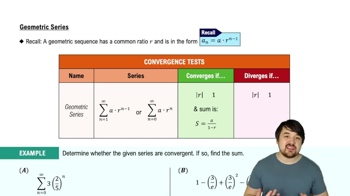
This video solution was recommended by our tutors as helpful for the problem above
Video duration:
1m
Play a video:
0 Comments
Key Concepts
Here are the essential concepts you must grasp in order to answer the question correctly.
Geometric Series Definition
A geometric series is a sum of terms where each term after the first is found by multiplying the previous term by a constant ratio r. It can be written as a + ar + ar² + ar³ + ... , where a is the first term and r is the common ratio.
The first term a of a geometric series is the initial term when the index k is zero. In the series ∑ from k=0 to ∞ of a × r^k, the first term is simply the coefficient multiplied by r raised to the zero power, which equals a.
The First Derivative Test: Finding Local Extrema Example 4
Common Ratio (r)
The common ratio r is the factor by which each term is multiplied to get the next term. It is the base of the exponent k in the series expression a × r^k, and it determines the behavior and convergence of the series.