Identify the type of series given. This is a geometric series where each term is of the form \(a r^k\), with \(a\) being the first term and \(r\) the common ratio.
Determine the first term \(a\) by substituting \(k=0\) into the term \(\left(-\frac{3}{4}\right)^k\). Since any number to the zero power is 1, \(a = 1\).
Identify the common ratio \(r\) as \(-\frac{3}{4}\), which is the base being raised to the power \(k\).
Use the formula for the sum of the first \(n+1\) terms of a geometric series:
\(S_{n} = a \frac{1 - r^{n+1}}{1 - r}\)
where \(n=9\) in this problem.
Substitute \(a = 1\), \(r = -\frac{3}{4}\), and \(n = 9\) into the formula to express the sum as
\(S_9 = \frac{1 - \left(-\frac{3}{4}\right)^{10}}{1 - \left(-\frac{3}{4}\right)}\).
Verified video answer for a similar problem:
This video solution was recommended by our tutors as helpful for the problem above
Video duration:
3m
Play a video:
0 Comments
Key Concepts
Here are the essential concepts you must grasp in order to answer the question correctly.
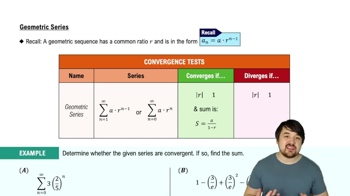
Geometric Series
A geometric series is the sum of the terms of a geometric sequence, where each term is found by multiplying the previous term by a constant ratio. The series has the form ∑ ar^k, where a is the first term and r is the common ratio.
The sum of the first n+1 terms of a geometric series is given by S_n = a(1 - r^(n+1)) / (1 - r), provided r ≠ 1. This formula allows quick calculation of the sum without adding each term individually.
Technology such as calculators or software can efficiently compute sums of series, especially when dealing with complex ratios or many terms. It helps verify manual calculations and handle more complicated expressions.

 3:32 minutes
 Verified step by step guidance
 06:00
06:00