
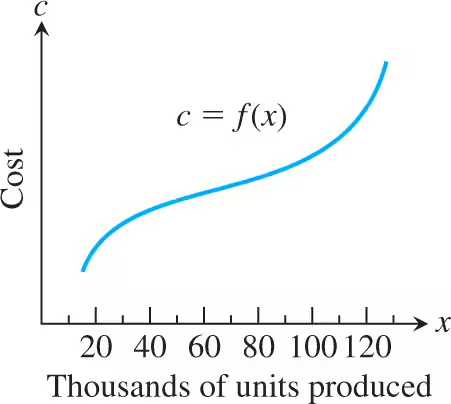
107. Marginal cost The accompanying graph shows the hypothetical cost c=f(x) of manufacturing x items. At approximately what production level does the marginal cost change from decreasing to increasing?
Verified step by step guidance
1
Step 1: Understand the concept of marginal cost. Marginal cost is the derivative of the cost function c=f(x) with respect to the number of items produced, x. It represents the rate of change of cost as production increases.
Step 2: Analyze the graph provided. The graph shows the cost function c=f(x) as a curve. To determine where the marginal cost changes from decreasing to increasing, we need to identify the point where the slope of the tangent to the curve transitions from decreasing to increasing.
Step 3: Look for the inflection point on the graph. An inflection point is where the curvature of the graph changes, which corresponds to the second derivative of the cost function changing sign. This is the point where the marginal cost transitions from decreasing to increasing.
Step 4: Estimate the production level at the inflection point. From the graph, observe the curve's behavior and approximate the x-value (production level) where the slope of the tangent stops decreasing and starts increasing. This appears to be around x=60 thousand units.
Step 5: Conclude that the marginal cost changes from decreasing to increasing at approximately x=60 thousand units. This is based on the visual analysis of the graph and the concept of inflection points.
Verified video answer for a similar problem:
This video solution was recommended by our tutors as helpful for the problem above
Video duration:
2m
Play a video:
0 Comments
Key Concepts
Here are the essential concepts you must grasp in order to answer the question correctly.
Marginal Cost
Marginal cost refers to the additional cost incurred when producing one more unit of a good or service. It is derived from the cost function, c = f(x), by calculating the derivative, f'(x). Understanding where marginal cost increases or decreases helps businesses make informed production decisions.
The cost function, represented as c = f(x), describes the total cost of producing x units of a product. It typically reflects fixed and variable costs and can be analyzed to determine how costs change with varying production levels. The shape of this function is crucial for identifying points of marginal cost change.
An inflection point on a graph is where the curvature changes, indicating a transition in the behavior of the function. In the context of marginal cost, it marks the production level where the marginal cost shifts from decreasing to increasing, which is essential for optimizing production efficiency and cost management.