
Textbook Question
Let ƒ(x) = 3x - x³ . Show that the equation ƒ(𝓍) = -4 has a solution in the interval [2,3] and use Newton’s method to find it.
187
views

 Verified step by step guidance
 05:59
05:59
 07:09
07:09 06:02
06:02Let ƒ(x) = 3x - x³ . Show that the equation ƒ(𝓍) = -4 has a solution in the interval [2,3] and use Newton’s method to find it.
Sketch the graph of a twice-differentiable function y=f(x) that passes through the points (-2,2), (-1,1), (0,0),(1,1), and (2,2) and whose first two derivatives have the following sign patterns.
In Exercises 121–124, find the inflection points (if any) on the graph of the function and the coordinates of the points on the graph where the function has a local maximum or local minimum value. Then graph the function in a region large enough to show all these points simultaneously. Add to your picture the graphs of the function’s first and second derivatives. How are the values at which these graphs intersect the x-axis related to the graph of the function? In what other ways are the graphs of the derivatives related to the graph of the function?
123. y=(4/5)x^5+16x^2-25
Graph f(x) = 2x^4 -4x^2 + 1 and its first two derivatives together. Comment on the behavior of f in relation to the signs and values of f' and f".
106. Motion Along a Line The graphs in Exercises 105 and 106 show the position s=f(t) of an object moving up and down on a coordinate line. At approximately what times is the (b) velocity equal to zero?
<IMAGE>
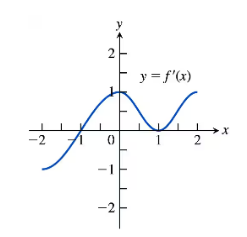
Each of Exercises 89–92 shows the graphs of the first and second derivatives of a function y=f(x). Copy the picture and add to it a sketch of the approximate graph of f, given that the graph passes through the point P.