Ch. 3 - Derivatives
Briggs - Calculus: Early Transcendentals 3rd Edition
Briggs3rd EditionCalculus: Early TranscendentalsISBN: 9780136847243Not the one you use?Change textbook
Chapter 3, Problem 3.7.25d

Derivatives using tables Let h(x)=f(g(x))h(x)=f(g(x)) and p(x)=g(f(x))p(x)=g(f(x)). Use the table to compute the following derivatives.
<IMAGE>
d. p(2)p^{\(\prime\)}\(\left\)(2\(\right\))

Verified step by step guidance
1
Identify that you need to find the derivative of the composite function p(x) = g(f(x)) at x = 2, which is p'(2).
Recall the chain rule for derivatives, which states that if you have a composite function p(x) = g(f(x)), then the derivative p'(x) = g'(f(x)) * f'(x).
Evaluate f(x) at x = 2 using the table to find f(2). This will give you the input for g'.
Use the table to find g'(f(2)), which is the derivative of g at the point f(2).
Find f'(2) using the table, which is the derivative of f at x = 2. Multiply g'(f(2)) by f'(2) to get p'(2).

Verified video answer for a similar problem:

This video solution was recommended by our tutors as helpful for the problem above.
Video duration:
2m
Was this helpful?

Key Concepts

Here are the essential concepts you must grasp in order to answer the question correctly.

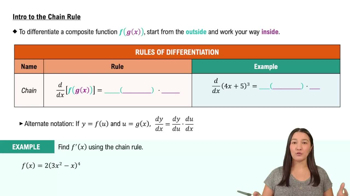
Chain Rule

The Chain Rule is a fundamental theorem in calculus used to differentiate composite functions. It states that if a function h(x) is composed of two functions f and g, such that h(x) = f(g(x)), then the derivative h'(x) can be found using the formula h'(x) = f'(g(x)) * g'(x). This rule is essential for calculating derivatives of functions that are nested within each other.
Recommended video:
05:02
Intro to the Chain Rule

Derivative Notation

Derivative notation, such as f'(x) or p'(2), represents the rate of change of a function with respect to its variable. The notation p'(2) specifically indicates the derivative of the function p evaluated at the point x = 2. Understanding this notation is crucial for interpreting and calculating derivatives accurately.
Recommended video:
04:22
Sigma Notation

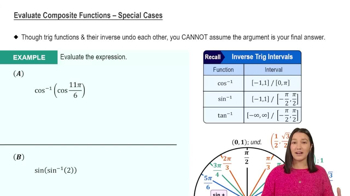
Function Composition

Function composition occurs when one function is applied to the result of another function. In the context of the question, h(x) = f(g(x)) and p(x) = g(f(x)) are examples of composed functions. Recognizing how to work with composed functions is vital for applying the Chain Rule and finding derivatives of such functions.
Recommended video:
3:48
Evaluate Composite Functions - Special Cases
Related Practice
Textbook Question

Witch of Agnesi Let y(x²+4)=8 (see figure). <IMAGE>

d. Verify that the results of parts (a) and (c) are consistent.

274
views

Textbook Question

97–100. Logistic growth Scientists often use the logistic growth function P(t) = P₀K / P₀+(K−P₀)e^−r₀t to model population growth, where P₀ is the initial population at time t=0, K is the carrying capacity, and r₀ is the base growth rate. The carrying capacity is a theoretical upper bound on the total population that the surrounding environment can support. The figure shows the sigmoid (S-shaped) curve associated with a typical logistic model. <IMAGE>


{Use of Tech} Gone fishing When a reservoir is created by a new dam, 50 fish are introduced into the reservoir, which has an estimated carrying capacity of 8000 fish. A logistic model of the fish population is P(t) = 400,000 / 50+7950e^−0.5t, where t is measured in years.


d. Graph P' and use the graph to estimate the year in which the population is growing fastest. 

235
views
Textbook Question

Derivatives using tables Let h(x)=f(g(x))h(x)=f(g(x)) and p(x)=g(f(x))p(x)=g(f(x)). Use the table to compute the following derivatives.

<IMAGE>

e. h(5)h^{\(\prime\)}\(\left\)(5\(\right\))

234
views
Textbook Question

Airline travel The following figure shows the position function of an airliner on an out-and-back trip from Seattle to Minneapolis, where s = f(t) is the number of ground miles from Seattle t hours after take-off at 6:00 A.M. The plane returns to Seattle 8.5 hours later at 2:30 P.M. <IMAGE>

d. Determine the velocity of the airliner at noon (t = 6) and explain why the velocity is negative.

220
views
Textbook Question

Derivatives of inverse functions from a table Use the following tables to determine the indicated derivatives or state that the derivative cannot be determined. <IMAGE>

d. f'(1)

215
views
Textbook Question

Explain why or why not Determine whether the following statements are true and give an explanation or counterexample.

d. The lines tangent to the graph of y=sin x on the interval [−π/2,π/2] have a maximum slope of 1.

207
views