Ch. 1 - Functions
Briggs - Calculus: Early Transcendentals 3rd Edition
Briggs3rd EditionCalculus: Early TranscendentalsISBN: 9780136847243Not the one you use?Change textbook
Chapter 1, Problem 82c

Composition of polynomials
Let ƒ be an nth-degree polynomial and let g be an mth-degree polynomial.
What is the degree of the following polynomials?
ƒ ⋅ f

Verified step by step guidance
1
Identify the degree of the polynomial \( f \), which is \( n \).
Understand that \( f \cdot f \) represents the composition of the polynomial \( f \) with itself.
Recall that the degree of a polynomial product \( f \cdot g \) is the sum of the degrees of \( f \) and \( g \).
Since \( f \cdot f \) is \( f \) composed with itself, the degree is \( n + n \).
Conclude that the degree of \( f \cdot f \) is \( 2n \).

Verified video answer for a similar problem:

This video solution was recommended by our tutors as helpful for the problem above.
Video duration:
1m
Was this helpful?

Key Concepts

Here are the essential concepts you must grasp in order to answer the question correctly.

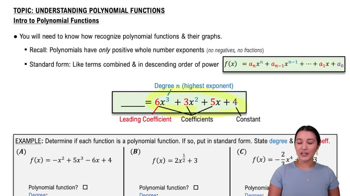
Degree of a Polynomial

The degree of a polynomial is the highest power of the variable in the polynomial expression. For example, in the polynomial f(x) = 3x^4 + 2x^2 + 1, the degree is 4. The degree provides important information about the polynomial's behavior, including the number of roots and the end behavior of its graph.
Recommended video:
6:04
Introduction to Polynomial Functions

Multiplication of Polynomials

When multiplying polynomials, the degree of the resulting polynomial is the sum of the degrees of the polynomials being multiplied. For instance, if f is an nth-degree polynomial and g is an mth-degree polynomial, then the degree of the product f ⋅ g is n + m. This principle is crucial for determining the degree of polynomial expressions resulting from operations.
Recommended video:
6:04
Introduction to Polynomial Functions

Composition of Polynomials

The composition of polynomials involves substituting one polynomial into another. For example, if f(x) is a polynomial and g(x) is another, then the composition f(g(x)) results in a new polynomial. While the question focuses on multiplication, understanding composition helps clarify how polynomials interact, especially in more complex expressions.
Recommended video:
6:04
Introduction to Polynomial Functions
Related Practice
Textbook Question

Symmetry Determine whether the graphs of the following equations and functions are symmetric about the x-axis, the y-axis, or the origin. Check your work by graphing.

ƒ(x)=x5x32ƒ(x)=x{^5}-x^3-2

328
views
Textbook Question

Symmetry Determine whether the graphs of the following equations and functions are symmetric about the x-axis, the y-axis, or the origin. Check your work by graphing.

x23+y23=1x^{\(\frac\)23}+y^{\(\frac\)23}=1

311
views
Textbook Question

Evaluating inverse trigonometric functions Without using a calculator, evaluate the following expressions.

tan(tan11)\(\tan\]\left\)(\(\tan\)^{-1}1\(\right\))

256
views
Textbook Question

Evaluating inverse trigonometric functions Without using a calculator, evaluate the following expressions.

tan1(tan(3π4))\(\tan\)^{-1}\(\left\)(\(\tan\[\left\)(\(\frac{3\pi}{4}\]\right\))\(\right\))

258
views
Textbook Question

A culture of bacteria has a population of 150150 cells when it is first observed. The population doubles every 12 hr12~\(\text{hr}\), which means its population is governed by the function p(t)=1502t12p\(\left\)(t\(\right\))=150\(\cdot{2^{\frac{t}{12}\)}}, where tt is the number of hours after the first observation.

How long does it take the population to reach 10,00010,000?

253
views
Textbook Question

Composition of polynomials

Let ƒ be an nth-degree polynomial and let g be an mth-degree polynomial.

What is the degree of the following polynomials?

ƒ o g

279
views