
Textbook Question
Identify the symmetry (if any) in the graphs of the following equations.
415
views

 Verified step by step guidance
 6:13
6:13
 4:49
4:49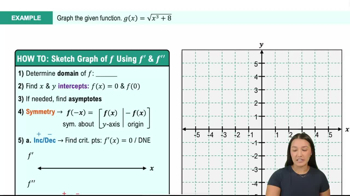 12:57
12:57Identify the symmetry (if any) in the graphs of the following equations.
Splitting up curves The unit circle x² + y² = 1 consists of four one-to-one functions, ƒ₁ (x), ƒ₂(x) , ƒ₃(x), and ƒ₄ (x) (see figure) <IMAGE>.
a. Find the domain and a formula for each function.
Evaluate and simplify the difference quotients (f(x + h) - f(x)) / h and (f(x) - f(a)) / (x - a) for each function.
f(x) = 7 / (x + 3)
Inverse of composite functions
b. Let g(x) = x² + 1 and h(x) = √x. Consider the composite function ƒ(x) = g(h(x)). Find ƒ⁻¹ directly and then express it in terms of g⁻¹ and h⁻¹
Splitting up curves The unit circle x² + y² = 1 consists of four one-to-one functions, ƒ₁ (x), ƒ₂(x) , ƒ₃(x), and ƒ₄ (x) (see figure)<IMAGE>.
b. Find the inverse of each function and write it as y= ƒ⁻¹ (x)
Inverse of composite functions
a. Let g(x) = 2x + 3 and h(x) = x³. Consider the composite function ƒ(x) = g(h(x)). Find ƒ⁻¹ directly and then express it in terms of g⁻¹ and h⁻¹