The terms of a sequence of partial sums are defined by Sₙ = ∑ⁿₖ₌₁ k² , for n=1, 2, 3, .....Evaluate the first four terms of the sequence.
Ch. 10 - Sequences and Infinite Series
Briggs3rd EditionCalculus: Early TranscendentalsISBN: 9780136847243Not the one you use?Change textbook
Chapter 10, Problem 10.8.67
11–86. Applying convergence tests Determine whether the following series converge. Justify your answers.
∑ (from j = 1 to ∞)cot(–1 / j) / 2ʲ
Verified step by step guidance1
Rewrite the general term of the series to better understand its behavior: the series is \( \sum_{j=1}^\infty \frac{\cot\left(-\frac{1}{j}\right)}{2^j} \). Note that \( 2^j \) grows exponentially, which suggests the denominator grows quickly.
Use the odd function property of cotangent: since \( \cot(-x) = -\cot(x) \), rewrite the term as \( \frac{-\cot\left(\frac{1}{j}\right)}{2^j} = -\frac{\cot\left(\frac{1}{j}\right)}{2^j} \). This helps simplify the analysis.
Analyze the behavior of \( \cot\left(\frac{1}{j}\right) \) as \( j \to \infty \). Since \( \frac{1}{j} \to 0 \), use the approximation \( \cot x \approx \frac{1}{x} \) for small \( x \). Thus, \( \cot\left(\frac{1}{j}\right) \approx j \).
Substitute the approximation into the term: \( -\frac{\cot\left(\frac{1}{j}\right)}{2^j} \approx -\frac{j}{2^j} \). Now consider the series \( \sum_{j=1}^\infty -\frac{j}{2^j} \).
Apply the Ratio Test or Root Test to the series \( \sum \frac{j}{2^j} \) to determine convergence. Since \( 2^j \) grows faster than any polynomial \( j \), the series converges absolutely, and thus the original series converges.

Verified video answer for a similar problem:
This video solution was recommended by our tutors as helpful for the problem above.
Video duration:
3mWas this helpful?
Key Concepts
Here are the essential concepts you must grasp in order to answer the question correctly.
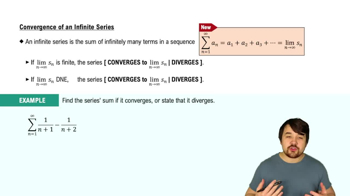
Convergence of Infinite Series
An infinite series converges if the sequence of its partial sums approaches a finite limit. Understanding convergence is essential to determine whether the sum of infinitely many terms results in a finite value or diverges to infinity or oscillates.
Recommended video:
Convergence of an Infinite Series
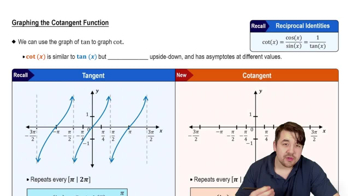
Behavior and Approximation of Functions for Small Arguments
Analyzing the behavior of functions like cotangent near zero helps simplify terms in a series. For small x, cot(x) can be approximated using series expansions, which aids in understanding the general term's behavior and applying convergence tests effectively.
Recommended video:
Introduction to Cotangent Graph
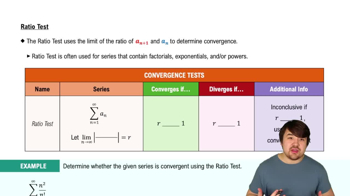
Convergence Tests for Series (Comparison and Ratio Tests)
Tests such as the Ratio Test and Comparison Test help determine series convergence by comparing terms to known convergent series or analyzing the limit of term ratios. These tests are crucial for series involving complex terms like cot(–1/j)/2^j.
Recommended video:
Ratio Test
Related Practice
Textbook Question
72
views
Textbook Question
11–86. Applying convergence tests Determine whether the following series converge. Justify your answers.
∑ (from k = 1 to ∞)sin(1 / k⁹)
46
views
Textbook Question
46–53. Decimal expansions
Write each repeating decimal first as a geometric series and then as a fraction (a ratio of two integers).
51.0.456̅ = 0.456456456…
67
views
Textbook Question
13–52. Limits of sequences
Find the limit of the following sequences or determine that the sequence diverges.
{(3n³ − 1)⁄(2n³ + 1)}
34
views
Textbook Question
11–86. Applying convergence tests Determine whether the following series converge. Justify your answers.
∑ (from k = 1 to ∞) 1 / (√k × e^(√k))
48
views
Textbook Question
32–49. Choose your test Use the test of your choice to determine whether the following series converge absolutely, converge conditionally, or diverge.
∑ (from k = 1 to ∞) (√k / k − 1)²ᵏ
41
views