
Textbook Question
13–20. Explicit formulas Write the first four terms of the sequence { aₙ }∞ₙ₌₁.
aₙ = (−1)ⁿ / 2ⁿ
47
views

 Verified step by step guidance
 06:52
06:52
 09:25
09:25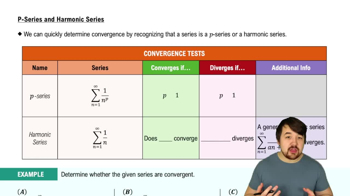 04:30
04:3013–20. Explicit formulas Write the first four terms of the sequence { aₙ }∞ₙ₌₁.
aₙ = (−1)ⁿ / 2ⁿ
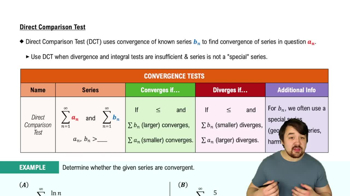
40–62. Choose your test Use the test of your choice to determine whether the following series converge.
∑ (k = 3 to ∞) 1 / lnk
23–38. Divergence, Integral, and p-series Tests Use the Divergence Test, the Integral Test, or the p-series test to determine whether the following series converge.
∑ (k = 1 to ∞) k^(1/k)
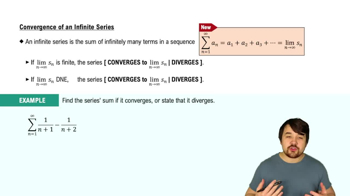
54–69. Telescoping series
For the following telescoping series, find a formula for the nth term of the sequence of partial sums {Sₙ}. Then evaluate limₙ→∞ Sₙ to obtain the value of the series or state that the series diverges.
61. ∑ (k = 1 to ∞) ln((k + 1) / k)
Why does the value of a converging alternating series with terms that are nonincreasing in magnitude lie between any two consecutive terms of its sequence of partial sums?
17–22. Integral Test Use the Integral Test to determine whether the following series converge after showing that the conditions of the Integral Test are satisfied.
∑ (k = 1 to ∞) 1 / (∛(5k + 3))